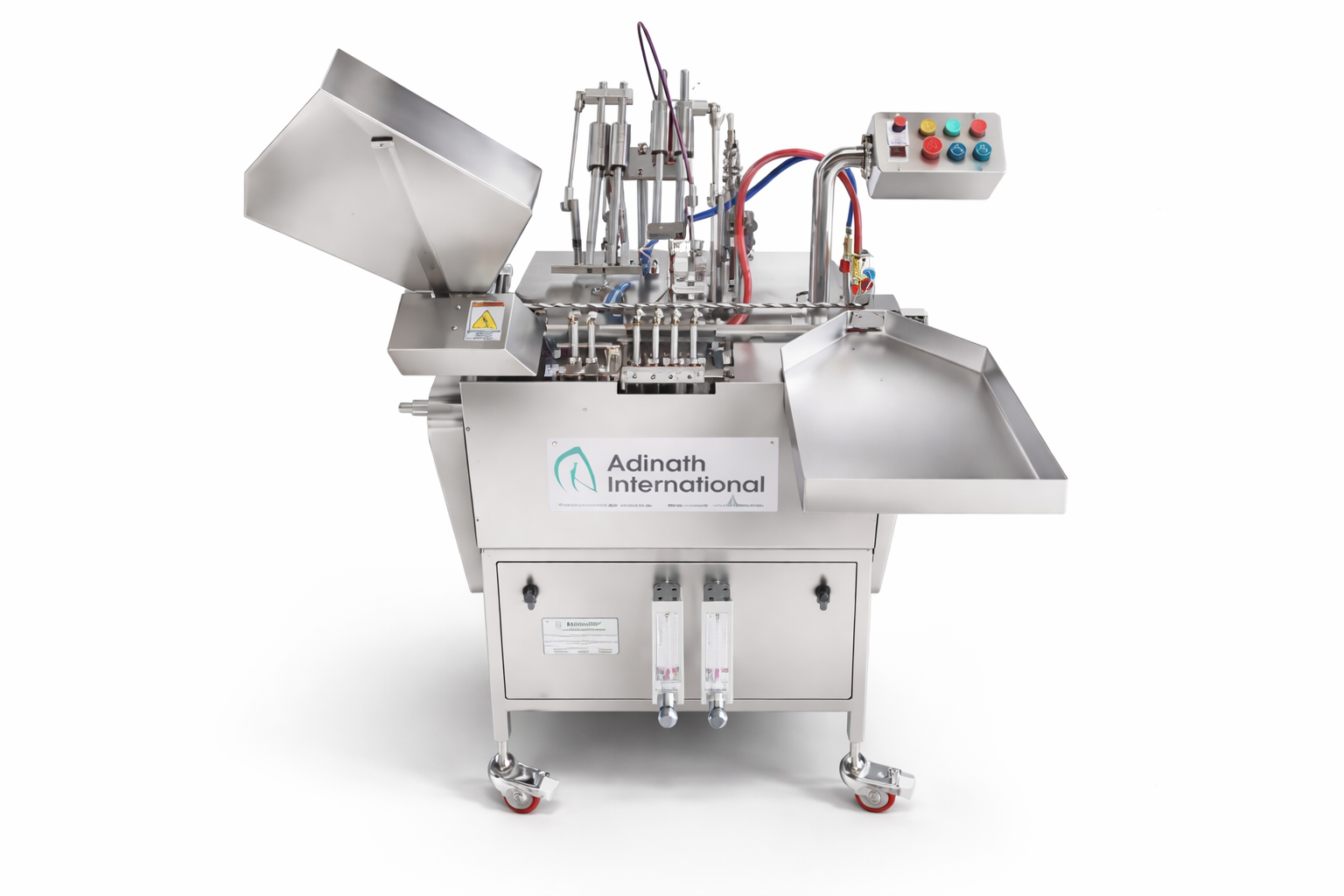
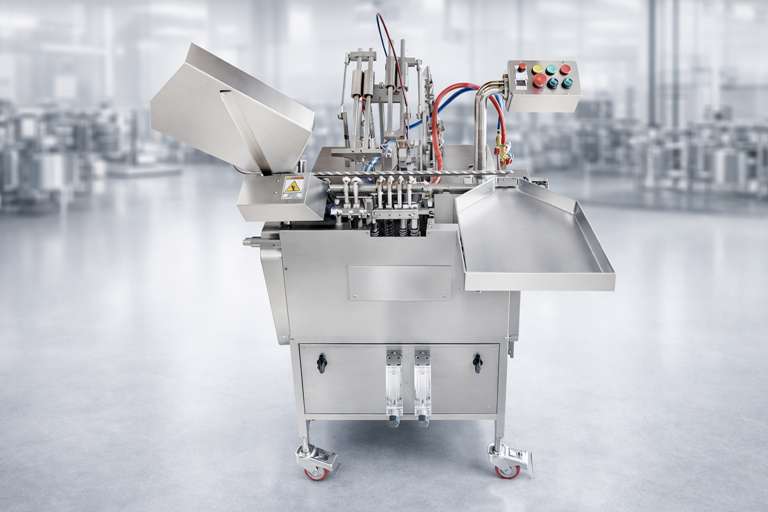
Our advanced Ampoule Filler and sealer systems streamline production across the pharmaceutical, biotech, cosmetic, veterinary, and chemical industries. To meet diverse production requirements, we engineer both standard and custom ampoule filling and sealing machines tailored precisely to your unique specifications.
Our advanced ampoule filling and sealing machine features a compact, monoblock design that seamlessly handles both filling and sealing on a single, unified platform. Built strictly in compliance with cGMP regulations, the entire structure is crafted from premium 316L stainless steel to ensure maximum hygiene and prevent contamination. By immediately sealing the glass ampoules post-filling, this automatic ampoule filler guarantees unmatched product integrity.
From initial washing to final hermetic sealing, processing glass ampoules requires absolute precision. Today’s pharmaceutical manufacturers face significant challenges, including strict cGMP regulations, tight production deadlines, and the delicate nature of glass containers.
Adinath International solves these manufacturing bottlenecks with state-of-the-art ampoule liquid filling lines engineered for gentle container handling, precise volumetric dosing, and secure flame sealing. Whether you need a compact system for small pilot batches or a high-speed automatic ampoule filling machine for large-scale commercial production, we custom-engineer every solution. Our equipment ensures seamless integration with your existing upstream and downstream pharmaceutical packaging systems.
Empty ampoules are placed onto hopper of the machine from where it has been dropped to travelling rack in one/two/four/eight by format part. Ampoules advanced to nitrogen purging stations where inert gas needles flush nitrogen. Further ampoules moves to filling unit where filling needles discharge preset volume of liquid into ampoules. Then ampoules stop at post nitrogen unit where again nitrogen get flush inside the ampule. After filling of ampoules it reaches to the sealing unit which is having pre warming and sealing stations. Pre warming station is having less pressure flame which make ampoule warm up to sealing process. Specially designed rollers rotates ampoules at sealing unit for perfect sealing of ampoules all around. Sealing unit perform sealing operation of ampoules. At last ampoules get collected onto collection tray of the machine in upright position for further processing.
The machine performs the following operations:
| Model | AFS-1 | AFS-2 | AFS-4 | AFS-8 |
| No. of Head | Single | Two | Four | Eight |
| Syringes | One | Double | Four | Eight |
| Ampoule Sizes | 1 ml to 30 ml | 1 ml to 30 ml | 1 ml to 20 ml | 1 ml to 20 ml |
| Filling Speed | Up to 25 ampoules/minute | Up to 50 ampoules/minute | Up to 100 ampoules/minute | Up to 200 ampoules/minute |
| Filling Precison | ± 1% | ± 1% | ± 1% | ± 1% |
| Filling Pump | Piston Pump | Piston Pump | Piston Pump | Piston Pump |
| Burner Gas | LPG & Oxygen (O₂) | LPG & Oxygen (O₂) | LPG & Oxygen (O₂) | LPG & Oxygen (O₂) |
| Nitrogen Arranegment | Before & After Filling | Before & After Filling | Before & After Filling | Before & After Filling |
| Number of Fill Nozzles | One | Two | Four | Eight |
| Number of Nitrogen Nozzles | Two | Four | Eight | Sixteen |
| Number of Sealing Burners | Two | Four | Eight | Sixteen |
| Power Required | 0.5 H.P. | 1 H.P. | 1 H.P. | 2 H.P. |
| Power Voltage | 230 Volts, Single Phase, 50 Hertz, 4 Wire System | 230 Volts, Single Phase, 50 Hertz, 4 Wire System | 230 Volts, Single Phase, 50 Hertz, 4 Wire System | 230 Volts, Single Phase, 50 Hertz, 4 Wire System |
| Contact Parts | Made from Stainless Steel 316L | Made from Stainless Steel 316L | Made from Stainless Steel 316L | Made from Stainless Steel 316L |
| Overall Dimension | 915mm (L) x 610mm (W) x 965mm (H) approx. | 915mm (L) x 760mm (W) x 965mm (H) approx. | 1200mm (L) x 1070mm (W) x 965mm (H) approx. | 2200mm (L) x 1400mm (W) x 1100mm (H) approx. |
* Power voltage can be adjusted as per customer’s domestic power voltage requirements.
* Rights of technical improvements & modification reserved.
* Illustrations & dimensions are shown for information purpose only.
1. Infeed and Transport System
2. Filling System (Core Dosing Unit)
3. Gassing System (for Oxygen-Sensitive Products)
4. Sealing System
5. Control and Safety Features
6. Other Supporting Components
An Ampoule Filler (also known as Automatic Ampoule Filling and Sealing Machine) is a compact monoblock pharmaceutical machine designed to fill and seal glass ampoules in a single operation. It uses volumetric piston pumps for precise liquid filling and gas burners for sealing. The machine supports nitrogen flushing before, during, and after filling to maintain product stability and is ideal for sterile injectable liquids in the pharmaceutical, biotech, cosmetic, and veterinary industries.
Our Ampoule Filler machines handle ampoule sizes from 1 ml to 30 ml (model dependent; e.g., 1-20 ml for multi-head models). Available models include:
Filling precision is ±1%, with special capacity from 0.5 ml to 25 ml in a single dose.
Yes. The machine is equipped with nitrogen flushing stations for pre-filling, during filling, and post-filling to prevent oxidation and maintain product integrity. It also features a “No Ampoule – No Filling” system that prevents the filling needles from dispensing liquid when an ampoule is missing, reducing product wastage and ensuring cleanliness.
All product contact parts are made from high-quality Stainless Steel 316L, while non-contact parts use Stainless Steel 304. The machine is designed as a compact model fully compliant with cGMP standards. It includes full accessibility for easy cleaning and maintenance, minimum change-over parts (especially for 1 ml to 10 ml sizes), and an active pre-heating unit for thick glass ampoules.
Empty ampoules are loaded into the hopper and transferred via a star wheel to a traveling rack. They undergo:
Sealed ampoules are collected upright on a tray (with a dead-tray for diversion). The entire process ensures minimal contamination, gentle handling, and high accuracy.
United States | Canada | Mexico | Brazil | Argentina | Chile | Colombia | Peru | Germany | United Kingdom | France | Italy | Spain | Netherlands | Belgium | Switzerland | Sweden | Austria | Denmark | Norway | Poland | Finland | Czech Republic | Hungary | Portugal | Ireland | Greece | Slovakia | Romania | Bulgaria | China | Japan | India | South Korea | Indonesia | Vietnam | Thailand | Malaysia | Philippines | Singapore | Bangladesh | Pakistan | Saudi Arabia | United Arab Emirates | Israel | Turkey | Iran | Qatar | Kuwait | South Africa | Nigeria | Egypt | Algeria | Morocco | Kenya | Ghana | Tunisia | Australia | New Zealand | Russia | Ukraine | Belarus | Kazakhstan | Taiwan | Hong Kong | South Sudan | Uzbekistan | Oman | Jordan | Bahrain | Sri Lanka | Myanmar | Lebanon | Mongolia | Ethiopia | Libya | Angola | Zambia | Zimbabwe | Mozambique | Ivory Coast | Senegal | Uganda | Tanzania | Botswana | Ecuador | Venezuela | Bolivia | Paraguay | Uruguay | Trinidad and Tobago | Panama | Guatemala | Costa Rica | Honduras | El Salvador | Nicaragua | Dominican Republic | Haiti | Cuba
Connect with our engineering team to discuss your specific production requirements. We provide customized, cGMP-compliant machinery solutions designed to optimize your manufacturing facility and maximize output.
Algeria | Angola | Argentina | Australia | Austria | Bahrain | Bangladesh | Belarus | Belgium | Bolivia | Botswana | Brazil | Bulgaria | Canada | Chile | China | Colombia | Costa Rica | Cuba | Czech Republic | Denmark | Dominican Republic | Ecuador | Egypt | El Salvador | Ethiopia | Finland | France | Germany | Ghana | Greece | Guatemala | Haiti | Honduras | Hong Kong | Hungary | India | Indonesia | Iran | Ireland | Israel | Italy | Ivory Coast | Japan | Jordan | Kazakhstan | Kenya | Kuwait | Lebanon | Libya | Malaysia | Mexico | Mongolia | Morocco | Mozambique | Myanmar | Netherlands | New Zealand | Nicaragua | Nigeria | Norway | Oman | Pakistan | Panama | Paraguay | Peru | Philippines | Poland | Portugal | Qatar | Romania | Russia | Saudi Arabia | Senegal | Slovakia | Singapore | South Africa | South Korea | South Sudan | Spain | Sri Lanka | Sweden | Switzerland | Taiwan | Tanzania | Thailand | Trinidad and Tobago | Tunisia | Turkey | Uganda | Ukraine | United Arab Emirates | United Kingdom | United States | Uruguay | Uzbekistan | Venezuela | Vietnam | Zambia | Zimbabwe
Connect with our engineering team to discuss your specific production requirements. We provide customized, cGMP-compliant machinery solutions designed to optimize your manufacturing facility and maximize output.
©Adinath International | Theme Developed By Pharma Machinery Manufacturer I Website updated on: 02 October 2026
WhatsApp us
