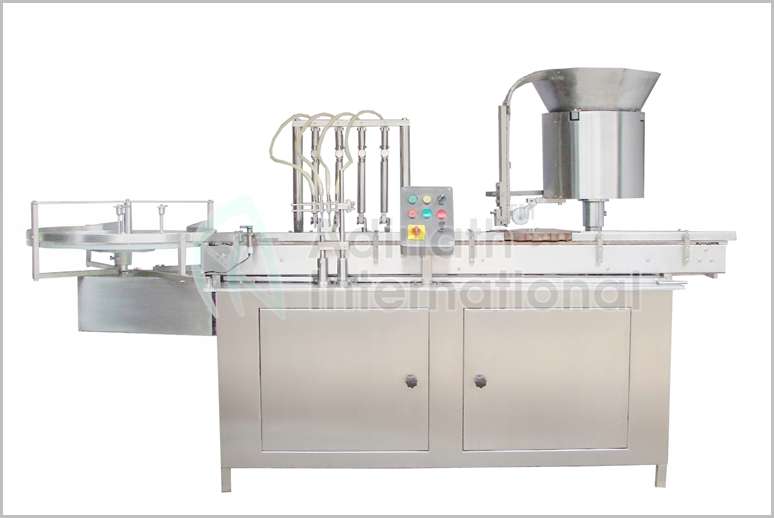
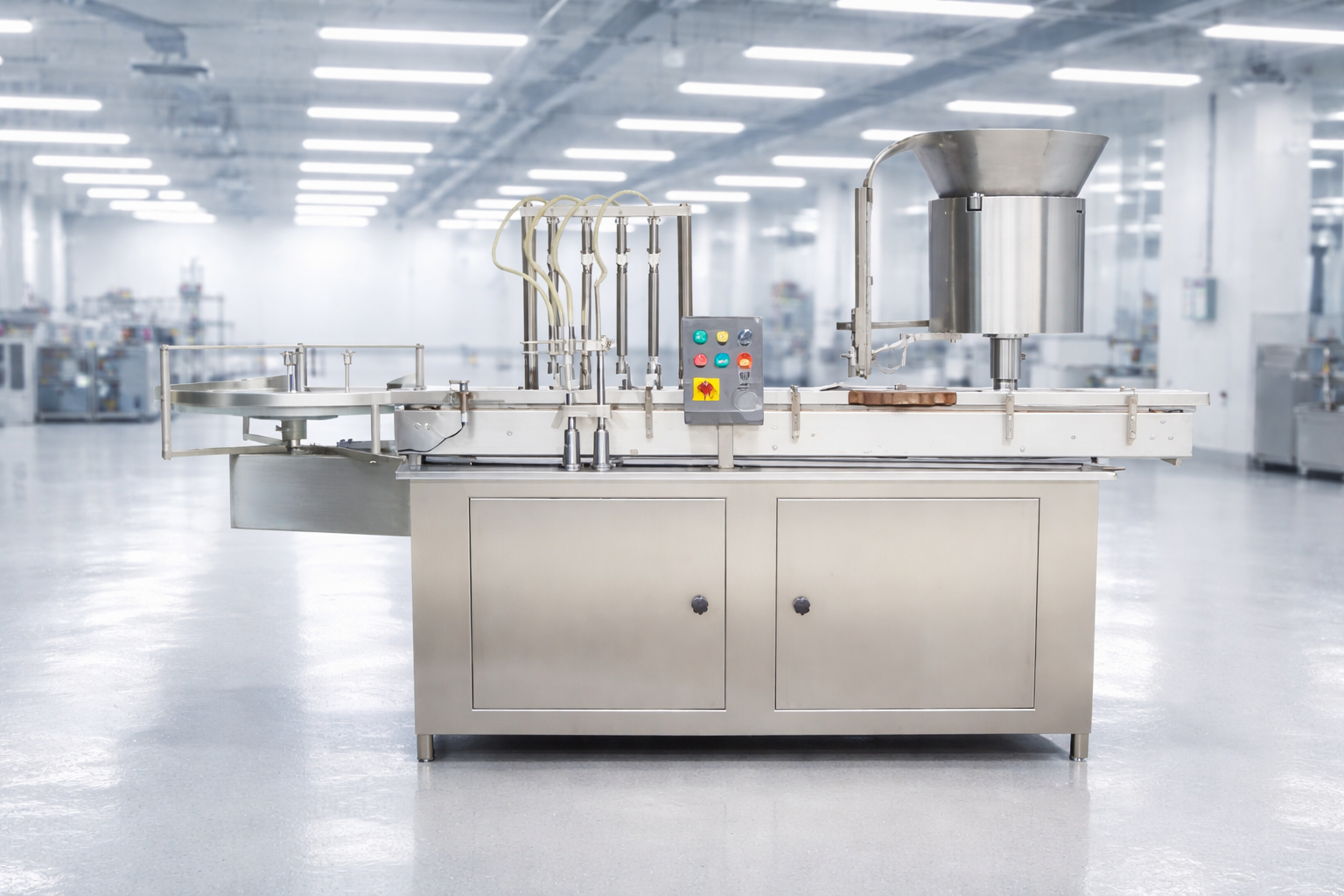
In the highly regulated pharmaceutical and chemical industries, the Glass Vial Filling Machine stands as a cornerstone of modern injectable manufacturing. Also known as a vial filling and bunging machine or vial filling and stoppering machine, this advanced automated system is specifically engineered to handle both liquid filling and rubber stoppering of injectable glass vials with exceptional accuracy and hygiene. Whether processing liquid injectables or powdered solids, these machines automate critical processes that once relied on manual labor, significantly boosting productivity while maintaining stringent quality and safety standards. Crafted from premium-grade materials, high-quality glass vial filling machines feature an attractive matt-finished stainless steel exterior that ensures durability, corrosion resistance, and easy cleaning. The core components include robust turntables, S.S. Stat conveyor belts, and specialized eccentric mechanisms for pre-gassing, filling, and post-gassing operations. Equipped with S.S. 316 syringes and non-toxic synthetic rubber tubing, these systems deliver precise dosing with minimal product wastage. Their compact, user-friendly control panels allow operators to monitor and adjust parameters effortlessly, making them ideal for high-speed, continuous production lines.
One of the most critical advantages of a modern pharmaceutical vial filling machine is the minimized risk of contamination. By positioning the filling and stoppering stations in close proximity, the machine reduces product exposure to the external environment. Designed explicitly for sterile manufacturing areas, these machines integrate seamlessly with laminar airflow protection systems. The un-scrambler and entire product path are engineered without dead ends or hard-to-clean zones, facilitating thorough sterilization and compliance with cGMP (current Good Manufacturing Practices) guidelines.
Pharmaceutical manufacturers prioritize accuracy, versatility, and sterility — qualities that a well-designed vial filling machine consistently delivers. These systems enhance process reliability by maintaining precise fill volumes regardless of liquid viscosity, thanks to advanced pump technologies such as peristaltic or piston pumps. They reduce human intervention, which directly lowers the possibility of microbial or particulate contamination. This is vital for injectable drugs where even minute impurities can compromise patient safety. Beyond operational efficiency, glass vial filling machines support scalability. From small-batch clinical trial production to large-scale commercial manufacturing, they offer flexibility while upholding the highest sterility standards. Their ability to handle both liquids and powders makes them versatile assets for companies producing vaccines, antibiotics, biologics, and other critical injectable formulations.
The operation of a glass vial filling machine typically follows a continuous or intermittent motion process designed for maximum throughput and minimal downtime:
This streamlined workflow ensures end-to-end protection in a controlled sterile environment.
For pharmaceutical companies aiming to meet global regulatory requirements while optimizing production, investing in a reliable glass vial filling machine is essential. Its combination of precision engineering, contamination control, and operational efficiency makes it indispensable in today’s competitive pharmaceutical landscape. Whether you’re upgrading existing lines or setting up a new facility, choosing the right vial filling and stoppering solution directly impacts product quality, patient safety, and operational success.
The incoming dry vials (sterilized and siliconized) are fed through the unscrambler and suitably guided on the moving Delrin slat conveyor belt at the required speed of the correct placement below filling unit.
The filling unit consists of Filling Head, Syringes & Nozzles; Syringes & Nozzles are made of AISI SS 316L materials. A Star Wheel is provided which holds the vial during filling operation. A sensor is provided for ”No Vial-No Filling” operation. Syringes are mounted on eccentric block and driving through bottom main gear box. Volume can be increase & decrease by increasing or decreasing stroke length of piston as per filling size. Syringes is having non return valve for sucking and delivering situation to avoid volume variation. Liquid reaches to filling nozzles through silicon transparent pipe. Nozzles having up & down movement with help of cam mechanism, and it come down when vial hold by starwheel for filling operation and starts filling when it starts to move up and after completion of filling operation, starwheel delivers two vials together on conveyor for rubber stoppering operation.
Stoppering unit consist of Star wheel, Vibrator unit and Bowl. The sterilized and siliconized rubber stoppers stored in the vibrator bowl moves vertically to the rubber stopper chute. The vial is hold firmly by starwheel, which will be in continuous rotary motion and vial which is coming from filling unit get in to starwheel and move in rotary direction along with starwheel, during movement it picks up the rubber stopper from the exit end of the chute and rubber stopper pressed by fix single pressing roller, which is spring loaded. Then vial further move on conveyor and collected on out feed starwheel for next sealing operation.
Model | ALVF-40 | ALVF-80 | ALVF-120 | ALVF – 250 |
Filling Heads | Two | Four | Eight | Twelve |
Production Rate | Up to 40 Vials/Minute | Up to 80 Vials/Minute | Up to 150 Vials/Minute | Up to 250 Vials/Minute |
Input Specification | ||||
Vial Diameter | 15mm to 70mm | 15mm to 70mm | 15mm to 70mm | 15mm to 70mm |
Vial Height | 25mm to 140mm | 25mm to 140mm | 25mm to 140mm | 25mm to 140mm |
Filling Precision | ±1% | ±1% | ±1% | ±1% |
Power Required | 1 H.P. | 1.5 H.P. | 2 H.P. | 2 H.P. |
Electrical Characteristics | 440 Volts, 3 Phase, 50 Hertz | 440 Volts, 3 Phase, 50 Hertz | 440 Volts, 3 Phase, 50 Hertz | 440 Volts, 3 Phase, 50 Hertz |
Overall Dimension | 2050mm (L) x 850mm (W) x 1700mm (H) | 2200mm (L) x 850mm (W) x 1700mm (H) | 3000mm (L) x 945mm (W) x 1700mm (H) | 3500mm (L) x 945mm (W) x 1700mm (H) |
* Power voltage can be adjusted as per customer’s domestic power voltage requirements.
* Rights of technical improvements & modification reserved.
* Illustrations & dimensions are shown for information purpose only.
Most modern automatic glass vial filling machines offer high precision, typically within a range of ±0.5% to ±1%. This accuracy is achieved through advanced piston pumps or peristaltic pump systems, ensuring minimal product wastage—which is critical for high-value pharmaceutical liquids.
Yes, these machines are designed for versatility. By using change parts (such as star wheels, feed worms, and syringes), a single machine can be adjusted to handle various vial diameters and fill volumes, ranging from 2 ml to 100 ml. Transition times are usually kept low to maintain production efficiency.
To meet strict cGMP standards, glass vial filling machines are often equipped with:
While standalone fillers exist, most industrial models are monoblock systems. This means the machine performs filling, rubber stoppering (bunging), and sometimes aluminum cap sealing on a single base. This integration reduces the footprint and minimizes the exposure of the open vial to the environment.
United States | Canada | Mexico | Brazil | Argentina | Chile | Colombia | Peru | Germany | United Kingdom | France | Italy | Spain | Netherlands | Belgium | Switzerland | Sweden | Austria | Denmark | Norway | Poland | Finland | Czech Republic | Hungary | Portugal | Ireland | Greece | Slovakia | Romania | Bulgaria | China | Japan | India | South Korea | Indonesia | Vietnam | Thailand | Malaysia | Philippines | Singapore | Bangladesh | Pakistan | Saudi Arabia | United Arab Emirates | Israel | Turkey | Iran | Qatar | Kuwait | South Africa | Nigeria | Egypt | Algeria | Morocco | Kenya | Ghana | Tunisia | Australia | New Zealand | Russia | Ukraine | Belarus | Kazakhstan | Taiwan | Hong Kong | South Sudan | Uzbekistan | Oman | Jordan | Bahrain | Sri Lanka | Myanmar | Lebanon | Mongolia | Ethiopia | Libya | Angola | Zambia | Zimbabwe | Mozambique | Ivory Coast | Senegal | Uganda | Tanzania | Botswana | Ecuador | Venezuela | Bolivia | Paraguay | Uruguay | Trinidad and Tobago | Panama | Guatemala | Costa Rica | Honduras | El Salvador | Nicaragua | Dominican Republic | Haiti | Cuba
Connect with our engineering team to discuss your specific production requirements. We provide customized, cGMP-compliant machinery solutions designed to optimize your manufacturing facility and maximize output.
Algeria | Angola | Argentina | Australia | Austria | Bahrain | Bangladesh | Belarus | Belgium | Bolivia | Botswana | Brazil | Bulgaria | Canada | Chile | China | Colombia | Costa Rica | Cuba | Czech Republic | Denmark | Dominican Republic | Ecuador | Egypt | El Salvador | Ethiopia | Finland | France | Germany | Ghana | Greece | Guatemala | Haiti | Honduras | Hong Kong | Hungary | India | Indonesia | Iran | Ireland | Israel | Italy | Ivory Coast | Japan | Jordan | Kazakhstan | Kenya | Kuwait | Lebanon | Libya | Malaysia | Mexico | Mongolia | Morocco | Mozambique | Myanmar | Netherlands | New Zealand | Nicaragua | Nigeria | Norway | Oman | Pakistan | Panama | Paraguay | Peru | Philippines | Poland | Portugal | Qatar | Romania | Russia | Saudi Arabia | Senegal | Slovakia | Singapore | South Africa | South Korea | South Sudan | Spain | Sri Lanka | Sweden | Switzerland | Taiwan | Tanzania | Thailand | Trinidad and Tobago | Tunisia | Turkey | Uganda | Ukraine | United Arab Emirates | United Kingdom | United States | Uruguay | Uzbekistan | Venezuela | Vietnam | Zambia | Zimbabwe
Connect with our engineering team to discuss your specific production requirements. We provide customized, cGMP-compliant machinery solutions designed to optimize your manufacturing facility and maximize output.
©Adinath International | Theme Developed By Pharma Machinery Manufacturer I Website updated on: 02 October 2026
WhatsApp us
