In the fast-paced pharmaceutical manufacturing industry, the Vial Filling and Rubber Stoppering Machine stands as a critical piece of equipment for ensuring accurate, sterile, and efficient production of injectable liquids. Designed with advanced engineering and strict compliance to Good Manufacturing Practices (GMP), these automatic vial filling machines deliver exceptional performance while maintaining the highest standards of product safety and quality. As experienced manufacturers with deep expertise in pharmaceutical filling technology, we understand the stringent requirements of injectable production and deliver solutions that professionals trust.
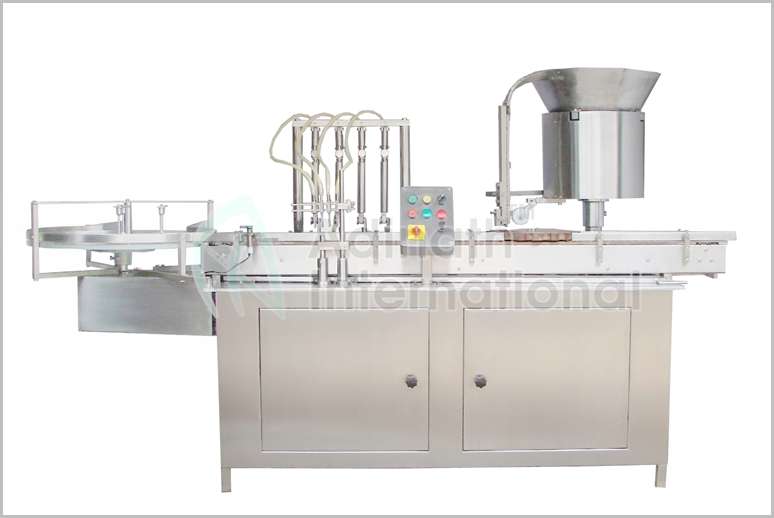
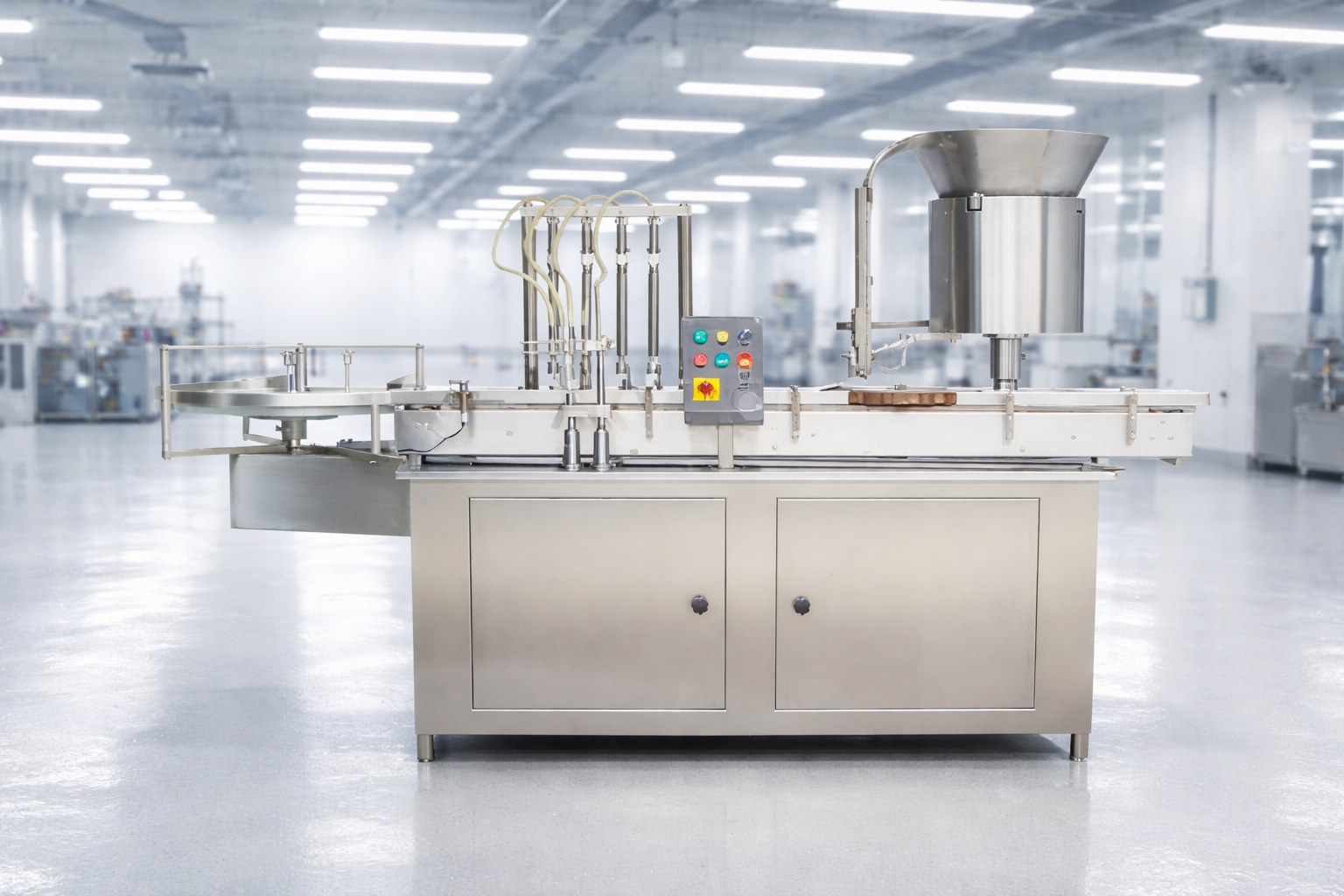
The main structure of a high-quality vial filling and rubber stoppering machine is built for durability and contamination control. It features a protective safety acrylic cover supported by a stainless steel frame, creating a sterile environment. Integrated laminar air flow systems maintain ISO-class cleanroom conditions throughout the operation. The machine includes an in-feed turntable, a reliable peristaltic pump filling system, a smooth Delrin slat conveyor, an outfeed turntable, a vibrator bowl with rubber stopper chute, precision pneumatic components, and a modern electrical panel equipped with AC drive, PLC, and user-friendly HMI interface. Sterilized dry vials are automatically fed through an unscrambler and precisely positioned on the moving Delrin slat conveyor belt. The conveyor speed is adjustable to ensure perfect synchronization with the filling station, minimizing any risk of misalignment or breakage.
An automatic vial filling machine is an efficient and highly accurate device specifically engineered for filling glass vials with liquid injectables. After precise liquid dosing, the machine seamlessly inserts rubber stoppers to seal the vials, protecting the product from external contaminants. Both peristaltic pumps and piston pumps are utilized depending on the application, offering the highest level of filling accuracy. For standard round vials, automatic models are the preferred choice due to their speed, consistency, and ability to handle high-throughput requirements. The system ensures rubber stoppers are correctly positioned on top of each container, creating a secure, tamper-evident seal that meets regulatory standards.
As one of the leading vial filling machine manufacturers, we prioritize precision engineering that results in minimal waste, zero spillage, and maximum uptime. Our machines are designed to prevent contamination at every stage — from vial feeding to final stoppering — ensuring product integrity and patient safety.
One of the standout features of modern vial liquid filling machines is their outstanding accuracy and productivity. These machines typically achieve filling precision of ±1%, even when handling rubber stoppers with a 20 mm diameter. The output rate depends on factors such as the type of liquid, fill volume, and machine configuration.
For example:
An eight-head vial filling machine can deliver up to 150 fills per minute.
A four-head model achieves around 80 fills per minute.
A two-head vial filler produces 40 fills per minute.
The versatile vial filler supports a wide fill range from 2 ml to 250 ml in a single machine with single dosing capability. It requires only a 2 H.P. electric supply, making it energy-efficient while maintaining powerful performance. This flexibility allows pharmaceutical companies to use the same equipment for different batch sizes and formulations, reducing operational costs and changeover time.
Key advantages include:
High workability and reliable high-speed operation
Advanced PLC and HMI controls for easy operation and monitoring
Stainless steel construction for easy cleaning and sterilization
Minimal maintenance requirements
Compliance with international pharmaceutical standards
Whether you operate a small-scale facility or a large pharmaceutical plant, our vial filling and rubber stoppering machines provide scalable solutions that grow with your production needs. The combination of robust design, cutting-edge filling technology, and operator-friendly features makes these machines a smart investment for consistent, high-quality output.
With years of hands-on experience in designing and supplying vial liquid filling equipment, we deliver machines that pharmaceutical manufacturers worldwide rely on for their most critical production lines. Our commitment to excellence, continuous innovation, and customer support ensures you receive not just equipment, but a complete, trustworthy solution for your injectable filling requirements. Ready to enhance your production efficiency with state-of-the-art vial filling technology? Contact our team today to explore customized automatic vial filling and rubber stoppering machines tailored to your specific needs.
The incoming dry vials (sterilized and siliconised) are fed through the in-feed turn table and suitably guided on the moving Stainless Steel slat conveyor belt at the required speed of the correct placement below filling unit.
The filling unit consists syringes & nozzles. Syringes are made of Stainless Steel 316L material for cGMP compliance. Vials stop below filling unit with centering of filling nozzles, during stoppage nozzles discharge pre determined liquid into vials. Duly filled vials delivered on stoppering unit which is mounted on same platform.
Stoppering Unit consist Bowl and Chute designed for desired stopper / bung size. Stoppers are stored in vibratory bowl and delivered to the vial through delivery chute. Vibratory bowl is equipped with special vibrator motor. Stoppers travel in vibratory bowl support guide through vibration. There is arrangement in the bowl in which wrong position stopper get rejected in travelling and only correct position of stopper get into chute. Further stoppers hold at delivery point of chute through spring which collected one by one by vial in traveling below the chute. Further there is one Stainless Steel 304 roller installed to press the stoppers. Vial transfer below the wheel in which get stoppered.
Duly stoppered vials further move on conveyor & collected on out feed turn table (optional) or on to conveyor of vial aluminum cap sealing machine for cap sealing operations.
Model | ALVF-40 | ALVF-80 | ALVF-120 | ALVF – 250 |
Filling Heads | Two | Four | Eight | Twelve |
Production Rate | Up to 40 Vials/Minute | Up to 80 Vials/Minute | Up to 150 Vials/Minute | Up to 250 Vials/Minute |
Input Specification | ||||
Vial Diameter | 15mm to 70mm | 15mm to 70mm | 15mm to 70mm | 15mm to 70mm |
Vial Height | 25mm to 140mm | 25mm to 140mm | 25mm to 140mm | 25mm to 140mm |
Filling Precision | ±1% | ±1% | ±1% | ±1% |
Power Required | 1 H.P. | 1.5 H.P. | 2 H.P. | 2 H.P. |
Electrical Characteristics | 440 Volts, 3 Phase, 50 Hertz | 440 Volts, 3 Phase, 50 Hertz | 440 Volts, 3 Phase, 50 Hertz | 440 Volts, 3 Phase, 50 Hertz |
Overall Dimension | 2050mm (L) x 850mm (W) x 1700mm (H) | 2200mm (L) x 850mm (W) x 1700mm (H) | 3000mm (L) x 945mm (W) x 1700mm (H) | 3500mm (L) x 945mm (W) x 1700mm (H) |
* Power voltage can be adjusted as per customer’s domestic power voltage requirements.
* Rights of technical improvements & modification reserved.
* Illustrations & dimensions are shown for information purpose only.
A Vial Filling and Rubber Stoppering Machine is a compact monoblock automatic system designed for aseptic filling of sterile liquid injectables into glass vials followed by precise rubber stopper (bung) insertion. It integrates filling and stoppering on a single platform under laminar airflow to minimize contamination risk. It is widely used in pharmaceutical and biotech industries for vaccines, antibiotics, and other parenteral products.
The machine delivers high filling accuracy of ±0.5% to ±1%. It uses advanced peristaltic pumps or piston pumps with SS 316L syringes and nozzles. Features like suck-back system (anti-dripping) and independent head operation ensure consistent dosing with minimal product wastage.
Sterilized rubber stoppers are loaded into a vibratory bowl. The oriented stoppers travel through a Teflon-coated chute and are placed onto the filled vials. A vacuum or mechanical hold disc and pressing roller ensure accurate and uniform stoppering. The system also rejects wrongly oriented stoppers automatically.
Important features include:
These features maintain sterility and minimize product loss.
Yes. The machine is fully cGMP compliant and meets USFDA, EU-GMP, and WHO standards. All contact parts are SS 316L and framework is SS 304. It can be customized with PLC + HMI, CIP/SIP capability, inbuilt laminar airflow, and IQ/OQ documentation. Minimal change parts are required for different vial sizes.
United States | Canada | Mexico | Brazil | Argentina | Chile | Colombia | Peru | Germany | United Kingdom | France | Italy | Spain | Netherlands | Belgium | Switzerland | Sweden | Austria | Denmark | Norway | Poland | Finland | Czech Republic | Hungary | Portugal | Ireland | Greece | Slovakia | Romania | Bulgaria | China | Japan | India | South Korea | Indonesia | Vietnam | Thailand | Malaysia | Philippines | Singapore | Bangladesh | Pakistan | Saudi Arabia | United Arab Emirates | Israel | Turkey | Iran | Qatar | Kuwait | South Africa | Nigeria | Egypt | Algeria | Morocco | Kenya | Ghana | Tunisia | Australia | New Zealand | Russia | Ukraine | Belarus | Kazakhstan | Taiwan | Hong Kong | South Sudan | Uzbekistan | Oman | Jordan | Bahrain | Sri Lanka | Myanmar | Lebanon | Mongolia | Ethiopia | Libya | Angola | Zambia | Zimbabwe | Mozambique | Ivory Coast | Senegal | Uganda | Tanzania | Botswana | Ecuador | Venezuela | Bolivia | Paraguay | Uruguay | Trinidad and Tobago | Panama | Guatemala | Costa Rica | Honduras | El Salvador | Nicaragua | Dominican Republic | Haiti | Cuba
Connect with our engineering team to discuss your specific production requirements. We provide customized, cGMP-compliant machinery solutions designed to optimize your manufacturing facility and maximize output.
Algeria | Angola | Argentina | Australia | Austria | Bahrain | Bangladesh | Belarus | Belgium | Bolivia | Botswana | Brazil | Bulgaria | Canada | Chile | China | Colombia | Costa Rica | Cuba | Czech Republic | Denmark | Dominican Republic | Ecuador | Egypt | El Salvador | Ethiopia | Finland | France | Germany | Ghana | Greece | Guatemala | Haiti | Honduras | Hong Kong | Hungary | India | Indonesia | Iran | Ireland | Israel | Italy | Ivory Coast | Japan | Jordan | Kazakhstan | Kenya | Kuwait | Lebanon | Libya | Malaysia | Mexico | Mongolia | Morocco | Mozambique | Myanmar | Netherlands | New Zealand | Nicaragua | Nigeria | Norway | Oman | Pakistan | Panama | Paraguay | Peru | Philippines | Poland | Portugal | Qatar | Romania | Russia | Saudi Arabia | Senegal | Slovakia | Singapore | South Africa | South Korea | South Sudan | Spain | Sri Lanka | Sweden | Switzerland | Taiwan | Tanzania | Thailand | Trinidad and Tobago | Tunisia | Turkey | Uganda | Ukraine | United Arab Emirates | United Kingdom | United States | Uruguay | Uzbekistan | Venezuela | Vietnam | Zambia | Zimbabwe
Connect with our engineering team to discuss your specific production requirements. We provide customized, cGMP-compliant machinery solutions designed to optimize your manufacturing facility and maximize output.
©Adinath International | Theme Developed By Pharma Machinery Manufacturer I Website updated on: 02 October 2026
WhatsApp us
