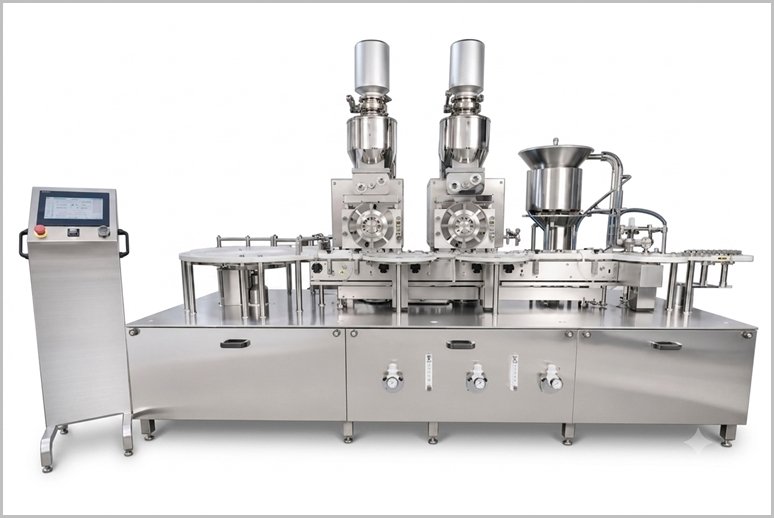
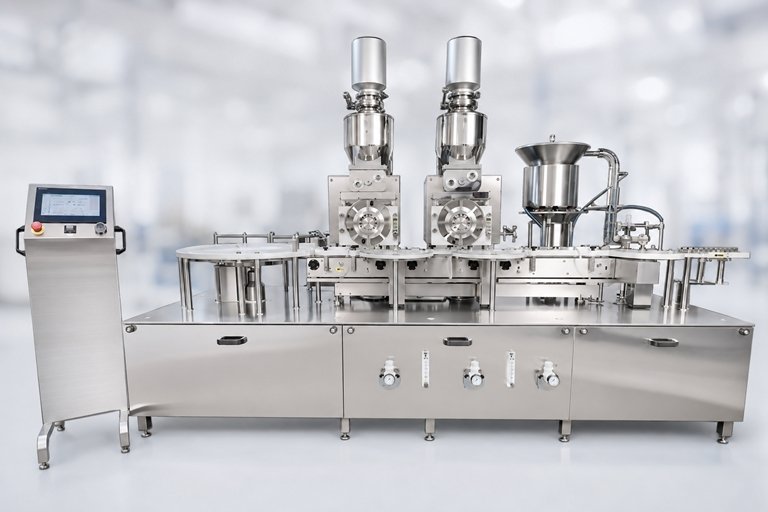
Dry Powder Filling Machine is an essential piece of industrial packaging equipment designed to accurately dispense dry powders into containers such as bottles, vials, jars, pouches, or cans. These machines are widely used across pharmaceutical, nutraceutical, food, chemical, and cosmetic industries where consistent dosing, product integrity, and operational efficiency are critical. Whether filling free-flowing powders like sugar or spices, or more challenging semi-free-flowing and cohesive materials, a well-engineered Dry Powder Filling Machine delivers the precision and reliability required for high-volume manufacturing.
Modern Dry Powder Filling Machines typically employ proven dosing technologies such as servo-driven augers, vacuum-and-air pressure systems, or volumetric cups. Servo-controlled augers, in particular, offer excellent accuracy and flexibility, allowing operators to achieve fill weights ranging from a few grams to several kilograms. Digital controls enable precise adjustment of fill parameters, while quick-change screws or tooling support rapid adaptation to different powder types and container sizes. This combination of accuracy and adjustability helps manufacturers maintain tight weight tolerances, reduce product giveaway, and meet regulatory labeling requirements.
Hygiene and durability form the foundation of any high-quality Dry Powder Filling Machine. Contact parts are commonly fabricated from 304 or 316 stainless steel, materials chosen for their corrosion resistance, ease of cleaning, and compatibility with sanitary standards. Easy-clean designs, smooth surfaces, and tool-free or quick-dismantle components support efficient sanitation between batches. Machines intended for pharmaceutical or food applications are engineered to comply with FDA and GMP guidelines, providing manufacturers with confidence in product safety and process validation. Dust control is another critical consideration when handling fine powders. Enclosed hoppers, vacuum extraction systems, and anti-static nozzles minimize airborne particles, protect the working environment, and reduce product loss. These features not only improve workplace safety and cleanliness but also help maintain consistent powder density and flow during the filling process.
Safety and operational reliability are further enhanced by intelligent interlocks. “No Container, No Fill” sensors prevent dosing when a bottle or package is absent, eliminating unnecessary waste of valuable powder. Overload protection and robust mechanical design safeguard both the equipment and the product. Many machines are also designed for seamless integration into complete packaging lines, connecting easily with upstream equipment such as blenders or conveyors and downstream systems including cappers, labelers, and coders.
Beyond individual features, the true value of a Dry Powder Filling Machine lies in its ability to increase productivity while lowering operational costs. Automation reduces labor dependency and human error, high-speed models support demanding production schedules, and consistent fill quality strengthens brand reputation. For manufacturers seeking a trustworthy, long-term packaging solution, these machines offer a proven combination of engineering expertise, hygienic construction, and process control. In summary, a Dry Powder Filling Machine represents a mature, reliable technology that addresses the practical challenges of powder packaging. By combining precise dosing, hygienic design, effective dust management, safety interlocks, and line integration capability, it enables efficient, compliant, and cost-effective production across a wide range of industries.
Properly cleaned containers are loaded onto the filling machine platform. From there, a conveyor belt transports the containers to the filling station. When a bottle is detected by the bottle sensor, the magnetic clutch mounted on the auger shaft begins to rotate. This rotation drives the auger, which dispenses the precise volume of powder into the container. Once filling is complete, the bottle continues along the conveyor for subsequent capping operations.
Models | AI-APF 1 | AI-APF 2 | AI-APF 3 |
Production Output | Up to 30 bottles/minute | Up to 60 bottles/minute | Up to 90 bottles/minute |
Fill Volume | 5gms. to 60gms. in Single Dose System | 5gms. to 60gms. in Single Dose System | 5gms. to 60gms. in Single Dose System |
Container Size | Custom made as per required container size | Custom made as per required container size | Custom made as per required container size |
Filling Accuracy | ± 2 – 3% in single dosing depending upon consistency and uniformity of bulk density of Powder | ± 2 – 3% in single dosing depending upon consistency and uniformity of bulk density of Powder | ± 2 – 3% in single dosing depending upon consistency and uniformity of bulk density of Powder |
Power Load | 2 H. P. | 3 H. P. | 4.5 H. P. |
Overall Dimension | 1810 mm (L) x 905 mm (W) x 1900 mm approx. | 2300 mm (L) x 905 mm (W) x 1900 mm approx. | 3000 mm (L) x 905 mm (W) x 1900 mm approx. |
Conveyor Height | 850 – 950 mm adjustable | 850 – 950 mm adjustable | 850 – 950 mm adjustable |
Electrical | 415VAC 3Phase and 220 VAC Single Phase Power Supply (50 Hz) with A.C. Drive | 415VAC 3Phase and 220 VAC Single Phase Power Supply (50 Hz) with A.C. Drive | 415VAC 3Phase and 220 VAC Single Phase Power Supply (50 Hz) with A.C. Drive |
* Power voltage can be adjusted as per customer’s domestic power voltage requirements.
* Rights of technical improvements & modification reserved.
* Illustrations & dimensions are shown for information purpose only.
A Dry Powder Filling Machine is an automated packaging system designed to accurately dose dry powders into containers such as glass bottles, vials, PET bottles, or jars. It is widely used in pharmaceutical, nutraceutical, food, and chemical industries for products like dry syrups, antibiotic powders, protein powders, and other free-flowing or semi-free-flowing formulations.
Most machines use vacuum and air pressure systems, auger dosing, or servo-controlled mechanisms. Containers are fed into the machine, precisely positioned (often with bottle-lifting and neck-holding systems), filled with the exact amount of powder, and then transferred for further processing such as capping or stoppering. Safety interlocks ensure filling occurs only when a container is present.
Dry Powder Filling Machines typically achieve accuracy of ±1% to ±2%, depending on the powder characteristics, fill volume, and environmental conditions such as humidity. Advanced models maintain consistent fill weights to meet regulatory and quality requirements.
These machines are suitable for free-flowing and semi-free-flowing dry powders. They can fill glass bottles, vials, PET bottles, and similar rigid containers across a range of sizes. Specialized features like vibratory systems help handle powders that tend to bridge or flow poorly.
Output varies by model and configuration. Semi-automatic machines suit lower volumes, while fully automatic rotary or linear systems can achieve speeds from 50 to over 200 containers per minute, depending on fill volume, powder type, and container size.
Product-contact parts are generally made from stainless steel SS316 or SS316L for corrosion resistance and easy sterilization. The machine structure is typically finished in stainless steel and designed to meet cGMP standards, supporting hygienic pharmaceutical manufacturing environments.
Standard features include “No Bottle – No Fill” (or “No Container – No Fill”) systems that prevent dosing when a container is absent. Bottle-lifting and neck-holding mechanisms further minimize spillage on the container exterior, reducing product loss and keeping bottles clean.
Contact parts are designed for easy removal and are compatible with cleaning, autoclaving, or sterilization processes. Quick-change parts and adjustable settings allow relatively fast changeovers between different container sizes or fill volumes, helping minimize downtime.
Key benefits include high dosing accuracy, reduced product wastage, improved hygiene and contamination control, higher production efficiency, lower labor dependency, and consistent quality that supports regulatory compliance. These advantages make the machines valuable for both small-batch and high-volume production.
These machines are extensively used in pharmaceuticals (dry syrups and injectables), nutraceuticals, herbal and Ayurvedic products, food powders, cosmetics, veterinary formulations, and specialty chemicals—wherever accurate, hygienic filling of dry powders into bottles or vials is required.
United States | Canada | Mexico | Brazil | Argentina | Chile | Colombia | Peru | Germany | United Kingdom | France | Italy | Spain | Netherlands | Belgium | Switzerland | Sweden | Austria | Denmark | Norway | Poland | Finland | Czech Republic | Hungary | Portugal | Ireland | Greece | Slovakia | Romania | Bulgaria | China | Japan | India | South Korea | Indonesia | Vietnam | Thailand | Malaysia | Philippines | Singapore | Bangladesh | Pakistan | Saudi Arabia | United Arab Emirates | Israel | Turkey | Iran | Qatar | Kuwait | South Africa | Nigeria | Egypt | Algeria | Morocco | Kenya | Ghana | Tunisia | Australia | New Zealand | Russia | Ukraine | Belarus | Kazakhstan | Taiwan | Hong Kong | South Sudan | Uzbekistan | Oman | Jordan | Bahrain | Sri Lanka | Myanmar | Lebanon | Mongolia | Ethiopia | Libya | Angola | Zambia | Zimbabwe | Mozambique | Ivory Coast | Senegal | Uganda | Tanzania | Botswana | Ecuador | Venezuela | Bolivia | Paraguay | Uruguay | Trinidad and Tobago | Panama | Guatemala | Costa Rica | Honduras | El Salvador | Nicaragua | Dominican Republic | Haiti | Cuba
Connect with our engineering team to discuss your specific production requirements. We provide customized, cGMP-compliant machinery solutions designed to optimize your manufacturing facility and maximize output.
Algeria | Angola | Argentina | Australia | Austria | Bahrain | Bangladesh | Belarus | Belgium | Bolivia | Botswana | Brazil | Bulgaria | Canada | Chile | China | Colombia | Costa Rica | Cuba | Czech Republic | Denmark | Dominican Republic | Ecuador | Egypt | El Salvador | Ethiopia | Finland | France | Germany | Ghana | Greece | Guatemala | Haiti | Honduras | Hong Kong | Hungary | India | Indonesia | Iran | Ireland | Israel | Italy | Ivory Coast | Japan | Jordan | Kazakhstan | Kenya | Kuwait | Lebanon | Libya | Malaysia | Mexico | Mongolia | Morocco | Mozambique | Myanmar | Netherlands | New Zealand | Nicaragua | Nigeria | Norway | Oman | Pakistan | Panama | Paraguay | Peru | Philippines | Poland | Portugal | Qatar | Romania | Russia | Saudi Arabia | Senegal | Slovakia | Singapore | South Africa | South Korea | South Sudan | Spain | Sri Lanka | Sweden | Switzerland | Taiwan | Tanzania | Thailand | Trinidad and Tobago | Tunisia | Turkey | Uganda | Ukraine | United Arab Emirates | United Kingdom | United States | Uruguay | Uzbekistan | Venezuela | Vietnam | Zambia | Zimbabwe
Connect with our engineering team to discuss your specific production requirements. We provide customized, cGMP-compliant machinery solutions designed to optimize your manufacturing facility and maximize output.
©Adinath International | Theme Developed By Pharma Machinery Manufacturer I Website updated on: 08 October 2026
WhatsApp us
