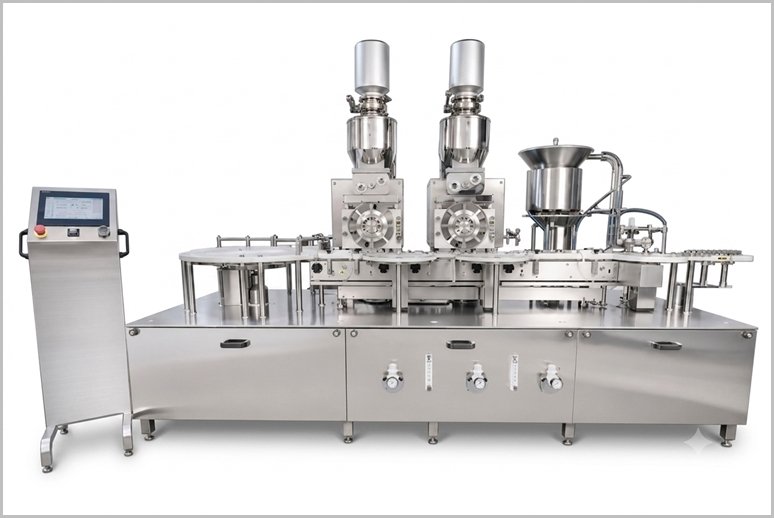
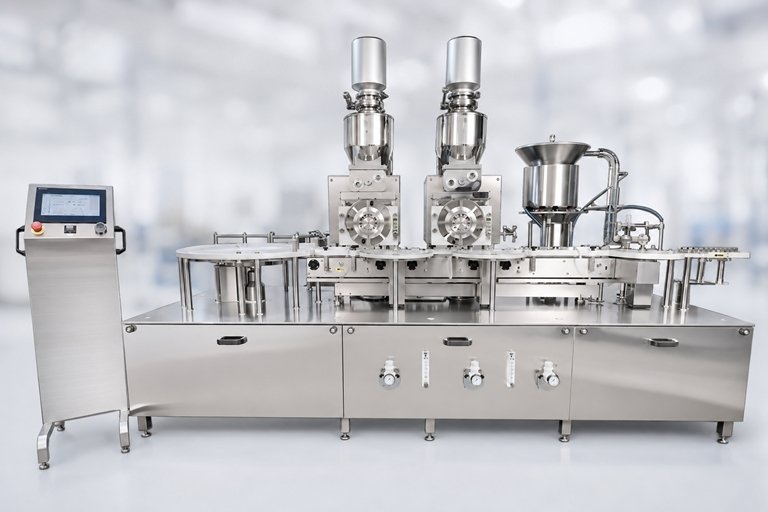
Injectable Powder Filling & Bunging Machine is an advanced pharmaceutical packaging solution designed for precise filling of sterile powders or liquids into glass vials followed by immediate rubber stoppering on a single integrated platform. This monobloc system is widely used in the production of injectable medicines, antibiotics, vaccines, and lyophilized products where aseptic conditions, dosage accuracy, and process efficiency are essential.
In sterile manufacturing environments, separate filling and stoppering stations can increase contamination risks and require more cleanroom space. A vial filling and rubber stoppering machine overcomes these challenges by combining both operations into one compact unit. Vials enter via an automatic infeed system, receive the exact dose of powder or liquid, and are then sealed with rubber stoppers before exiting—all under controlled conditions that support cGMP compliance.
High-speed automated operation reduces reliance on manual labor while maintaining consistent output. Rotary bottle movement systems, often paired with star wheels or precision conveyors, ensure smooth vial transport and accurate positioning during filling and stoppering. For dry powder applications, specialized powder wheels or vibratory funnel systems handle semi-free-flowing powders efficiently, enabling higher speeds without compromising fill quality. Filling accuracy is typically maintained within ±2%, depending on powder characteristics and controlled humidity levels (ideally below 28% RH).
Safety and product integrity are prioritized through multiple interlocks. The “No Vial – No Fill” system prevents powder or liquid wastage by ensuring dosing occurs only when a vial is correctly present. Additional protections include automatic machine stop functions for low air pressure, low vacuum, or absence of bottles at the infeed. These features protect expensive sterile materials and minimize production interruptions.
Hygiene remains central to the design. Product-contact parts are commonly manufactured from SS 316L stainless steel and engineered for easy removal, supporting thorough cleaning, autoclaving, or sterilization between batches. The overall machine construction often uses SS 304 for structural components, while toughened glass safety cabinets provide operator protection and maintain a controlled working environment. Tool-less adjustments for components such as doctor blades and wiper blades allow rapid changeovers and reduce downtime during format switches.
Versatility is another key strength. These machines accommodate a range of vial sizes and rubber stopper diameters through quick-change parts. Many models support single or multiple dosing, half or full bunging for lyophilized products, and integration with upstream washing/sterilizing lines or downstream capping systems. PLC-based controls with HMI interfaces enable recipe storage, real-time monitoring, and user-friendly operation, helping manufacturers meet regulatory documentation requirements such as IQ/OQ validation.
From a production standpoint, the vial filling and rubber stoppering machine delivers measurable advantages: higher throughput, reduced labor costs, lower product waste, improved batch consistency, and stronger compliance with aseptic manufacturing standards. By combining precise dosing with reliable stopper placement in a dust-free, hygienic design, it helps pharmaceutical companies maintain product quality while optimizing operational efficiency. Manufacturers seeking reliable, high-performance equipment for sterile injectable packaging recognize the value of a well-engineered vial filling and rubber stoppering machine. When properly specified, validated, and maintained, it supports consistent, high-quality output that meets both regulatory expectations and patient safety requirements.
Sterilized powder stored in the powder hopper is continuously agitated by a pair of mechanical agitators to maintain consistent flow and uniform bulk density. A powder wheel with eight ports rotates at a pre-determined speed directly beneath the hopper with virtually no clearance. Each port contains a piston, and a vacuum plate is positioned behind the powder wheel. Spring pressure ensures zero clearance between the powder wheel and the vacuum plate.
A precise volume of powder is drawn into each port under vacuum. Different fill sizes are achieved by adjusting the piston length. Excess powder is removed by a doctor blade, which can be adjusted externally without removing the powder hopper. As the powder wheel indexes further, the powder remains held in the port by vacuum until it reaches the position directly above the container. At this point, a timed pulse of sterilized low-pressure compressed air (or nitrogen) sequentially ejects the powder from the port into the waiting container.
Immediately after filling, the containers are separated on the conveyor by a vial separator and proceed to the stoppering station. (Different groove separators can be used depending on container diameter or for multiple dosing systems.) Sterilized and siliconized rubber stoppers are stored in a vibratory bowl, from which they are oriented and stacked vertically in the rubber stopper chute. Each container is firmly held between a pair of timing belts so that it can pick up a rubber stopper from the exit end of the chute. The container then passes between two pressing rollers that securely seat the rubber stopper for a tight fit.
Models | APF 12S | APF 12D |
Production Output | Up to 100 vials/minute | Up to 200 vials/minute |
Fill Volume | 50 mg. to 10grams | 50 mg. to 10 grams |
Vial Size | 5ml to 250ml | 5ml to 250ml |
Filling Accuracy | ± 2 – 3% in single dosing depending upon consistency and uniformity of bulk density of Injectable Powder | ± 2 – 3% in single dosing depending upon consistency and uniformity of bulk density of Injectable Powder |
Power Load | 3.5 H. P. | 4.5 H. P. |
Overall Dimension | 2600mm (L) X 1100mm (W) X 1800mm (H) approx. | 3000mm (L) X 1100mm (W) X 1800mm (H) approx. |
Net Weight | 500 kgs. approx. | 700 kgs. approx. |
Gross Weight | 750 kgs. approx. | 950 kgs. approx. |
* Power voltage can be adjusted as per customer’s domestic power voltage requirements.
* Rights of technical improvements & modification reserved.
* Illustrations & dimensions are shown for information purpose only.
An Injectable Powder Filling & Bunging Machine (also called a Vial Filling and Rubber Stoppering Machine) is a monobloc pharmaceutical system that accurately fills sterile dry powders into glass vials and immediately inserts rubber stoppers on the same platform. It is widely used for antibiotics, vaccines, lyophilized products, and other injectable formulations under aseptic conditions.
Sterilized powder is agitated in the hopper to maintain uniform density. A vacuum-driven powder wheel draws a precise volume of powder into each port. Excess powder is scraped by a doctor blade. When the port aligns over the vial, a pulse of sterilized low-pressure air or nitrogen ejects the powder into the vial. The filled vial then moves to the integrated rubber stoppering station, where a vibratory bowl orients and inserts the stopper, which is firmly seated by pressing rollers.
The machine typically achieves a filling accuracy of ±2% to ±3% in single dosing. Accuracy depends on the consistency and bulk density of the injectable powder as well as controlled environmental conditions (ideally low humidity).
Depending on the model, output ranges from up to 100 vials per minute (APF 12S – single powder wheel) to up to 200 vials per minute (APF 12D – double powder wheel).
It can process vials from 5 ml to 250 ml and fill volumes from 50 mg to 10 grams. Multiple dosing is possible with the help of change parts.
Yes. All product-contact parts are made of SS 316L stainless steel with an easy-removal system for cleaning, autoclaving, and sterilization. The compact cGMP design, optional laminar airflow, and integrated bunging support aseptic processing and help maintain product integrity.
Yes. It features a built-in rubber stoppering unit. Sterilized and siliconized rubber stoppers are automatically oriented in a vibratory bowl, fed through a chute, and securely inserted into the filled vials using timing belts and pressing rollers. Both half and full bunging options are available (useful for lyophilized products).
Key features include the “No Vial – No Fill” system to prevent powder wastage, safety clutch to avoid vial breakage, individual drives for filling and sealing, overload protection, variable AC frequency drive for speed control, digital production counter, and optional PLC with HMI for recipe management and monitoring.
Yes. IQ/OQ validation documentation can be supplied on request to support regulatory compliance, qualification activities, and cGMP documentation requirements.
Yes. It can be seamlessly connected with upstream vial washing machines and sterilization tunnels, as well as downstream capping machines, labeling systems, and inspection equipment to form a complete sterile injectable powder filling line.
United States | Canada | Mexico | Brazil | Argentina | Chile | Colombia | Peru | Germany | United Kingdom | France | Italy | Spain | Netherlands | Belgium | Switzerland | Sweden | Austria | Denmark | Norway | Poland | Finland | Czech Republic | Hungary | Portugal | Ireland | Greece | Slovakia | Romania | Bulgaria | China | Japan | India | South Korea | Indonesia | Vietnam | Thailand | Malaysia | Philippines | Singapore | Bangladesh | Pakistan | Saudi Arabia | United Arab Emirates | Israel | Turkey | Iran | Qatar | Kuwait | South Africa | Nigeria | Egypt | Algeria | Morocco | Kenya | Ghana | Tunisia | Australia | New Zealand | Russia | Ukraine | Belarus | Kazakhstan | Taiwan | Hong Kong | South Sudan | Uzbekistan | Oman | Jordan | Bahrain | Sri Lanka | Myanmar | Lebanon | Mongolia | Ethiopia | Libya | Angola | Zambia | Zimbabwe | Mozambique | Ivory Coast | Senegal | Uganda | Tanzania | Botswana | Ecuador | Venezuela | Bolivia | Paraguay | Uruguay | Trinidad and Tobago | Panama | Guatemala | Costa Rica | Honduras | El Salvador | Nicaragua | Dominican Republic | Haiti | Cuba
Connect with our engineering team to discuss your specific production requirements. We provide customized, cGMP-compliant machinery solutions designed to optimize your manufacturing facility and maximize output.
Algeria | Angola | Argentina | Australia | Austria | Bahrain | Bangladesh | Belarus | Belgium | Bolivia | Botswana | Brazil | Bulgaria | Canada | Chile | China | Colombia | Costa Rica | Cuba | Czech Republic | Denmark | Dominican Republic | Ecuador | Egypt | El Salvador | Ethiopia | Finland | France | Germany | Ghana | Greece | Guatemala | Haiti | Honduras | Hong Kong | Hungary | India | Indonesia | Iran | Ireland | Israel | Italy | Ivory Coast | Japan | Jordan | Kazakhstan | Kenya | Kuwait | Lebanon | Libya | Malaysia | Mexico | Mongolia | Morocco | Mozambique | Myanmar | Netherlands | New Zealand | Nicaragua | Nigeria | Norway | Oman | Pakistan | Panama | Paraguay | Peru | Philippines | Poland | Portugal | Qatar | Romania | Russia | Saudi Arabia | Senegal | Slovakia | Singapore | South Africa | South Korea | South Sudan | Spain | Sri Lanka | Sweden | Switzerland | Taiwan | Tanzania | Thailand | Trinidad and Tobago | Tunisia | Turkey | Uganda | Ukraine | United Arab Emirates | United Kingdom | United States | Uruguay | Uzbekistan | Venezuela | Vietnam | Zambia | Zimbabwe
Connect with our engineering team to discuss your specific production requirements. We provide customized, cGMP-compliant machinery solutions designed to optimize your manufacturing facility and maximize output.
©Adinath International | Theme Developed By Pharma Machinery Manufacturer I Website updated on: 08 October 2026
WhatsApp us
