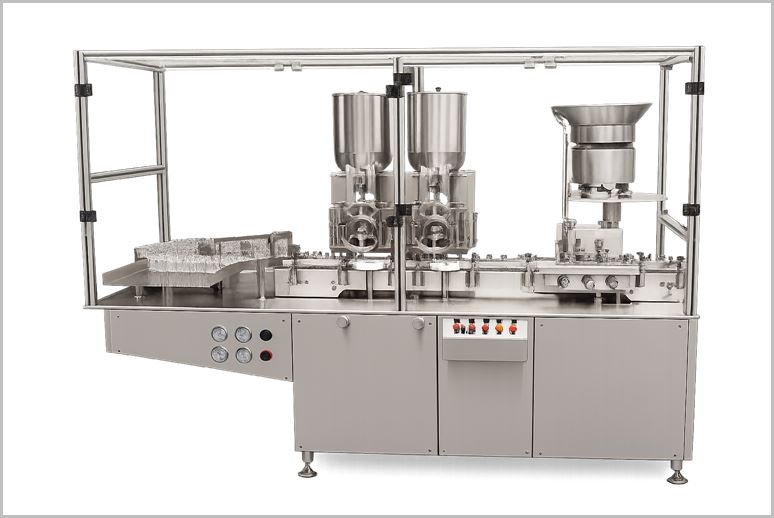
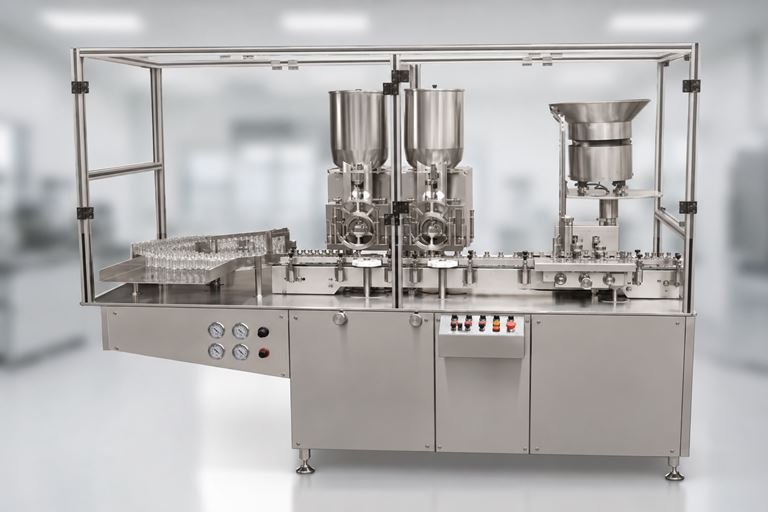
Injectable Powder Filling & Capping Machine is a high-precision, monobloc pharmaceutical packaging system engineered for the aseptic filling of sterile dry powders into glass vials, followed by rubber stoppering and aluminum flip-off or tear-off capping — all on a single integrated platform. Designed specifically for the demanding requirements of injectable manufacturing, this machine delivers accurate dosing, secure sealing, and consistent performance under controlled cleanroom conditions.
In modern sterile production environments, maintaining product integrity while maximizing efficiency is critical. Traditional multi-station lines increase the risk of contamination and consume valuable cleanroom space. The Injectable Powder Filling & Capping Machine overcomes these challenges by combining powder filling, rubber bunging, and final capping into one compact unit. Vials are automatically fed, precisely filled with sterile powder using a vacuum-driven powder wheel system, immediately stoppered with sterilized siliconized rubber stoppers, and then securely capped with aluminum seals — all under laminar airflow support that helps uphold aseptic standards.
Filling accuracy is typically maintained within ±2% to ±3%, depending on powder bulk density, particle characteristics, and controlled humidity levels. This level of precision is essential for dosage uniformity in antibiotics, vaccines, oncology formulations, lyophilized products, and other injectable powders. The machine supports a wide fill range (commonly from 50 mg to several grams) and accommodates various vial sizes, offering flexibility for different product strengths through single or multiple dosing options with quick-change parts.
All product-contact parts are manufactured from SS 316L stainless steel and designed for easy removal, enabling thorough cleaning, autoclaving, and sterilization between batches. Structural components follow cGMP guidelines, while safety interlocks such as “No Vial – No Fill,” clutch protection against vial breakage, and automatic stop functions for missing stoppers or low pressure minimize product wastage and protect expensive sterile materials. Servo or variable frequency drives ensure smooth vial transport and synchronized operation of filling, stoppering, and capping stations, reducing mechanical stress and improving overall equipment reliability.
From an operational standpoint, the integrated design significantly shortens the production line, lowers labor requirements, and improves batch consistency. Manufacturers benefit from higher throughput (models typically ranging from 100 to 200 vials per minute), faster changeovers, and reduced cleanroom footprint. Optional PLC with HMI interfaces allow recipe storage, real-time monitoring, and easier validation support, including IQ/OQ documentation when required.
This machine is widely trusted by pharmaceutical, biotech, and injectable manufacturers who prioritize sterility assurance, regulatory compliance, and long-term process reliability. When properly specified, validated, and maintained, the Injectable Powder Filling & Capping Machine helps companies achieve consistent product quality, minimize contamination risks, and optimize sterile packaging operations — ultimately supporting safer medicines for patients worldwide.
Sterilized dry bottles enter the machine through the in-feed turntable. Suitable guides then transfer the bottles onto the flat conveyor belt at the required speed for controlled feeding. The filling head is mounted on the machine’s top plate in the same line. When a bottle reaches the mechanical holder at the filling station, the bottle sensor detects its presence. This activates the magnetic clutch mounted on the auger shaft, which begins rotating. The auger then dispenses the predetermined quantity of powder into the bottle, based on the pre-set rotation time. Once filled, the bottles are conveyed upward to the sealing station by the stainless steel (SS) conveyor belt.
Models | AI-DPM 12 | AI-DPM 16 |
Production Output | Up to 80 bottles/minute | Up to 120 bottles/minute |
Bottle Diameter | Up to 85mm | Up to 85mm |
Bottle Height | Up to 200mm | Up to 200mm |
Fill Volume | 5gms. To 70gms. in Single Dose with the help of change parts for different fill volume | 5gms. To 70gms. in Single Dose with the help of change parts for different fill volume |
Fill Accuracy | ± 2% Depending upon the Powder, under the controlled level of Humidity | ± 2% Depending upon the Powder, under the controlled level of Humidity |
Humidity | Below 28% Rh required on machine to be arrange by customer | Below 28% Rh required on machine to be arrange by customer |
Power | 2.0 H.P. For Machine and 3.0 H.P. For Vacuum Pump | 2.5 H.P. For Machine and 3.0 H.P. For Vacuum Pump |
Overall Dimension | 1700 mm (L) x 1000 mm (W) x 1800 mm approx. | 2000 mm (L) x 1200 mm (W) x 1800 mm approx. |
* Power voltage can be adjusted as per customer’s domestic power voltage requirements.
* Rights of technical improvements & modification reserved.
* Illustrations & dimensions are shown for information purpose only.
An Injectable Powder Filling & Capping Machine is a high-precision monoblock pharmaceutical packaging system that combines sterile dry powder filling, rubber stoppering, and aluminum flip-off or tear-off capping on a single integrated platform. It is specifically designed for aseptic filling of injectable powders such as antibiotics, vaccines, lyophilized products, and other moisture-sensitive formulations into glass vials.
an in-feed turntable and are transferred onto a conveyor. At the filling station, a sensor detects the vial and activates the dosing system (auger or vacuum-driven powder wheel) to dispense a precise quantity of powder. The filled vial then moves to the rubber stoppering station, followed by the capping station where an aluminum seal is applied — all within the same compact machine.
The machine achieves a filling accuracy of ±2% (depending on powder characteristics) when operated under controlled humidity below 28% RH.
Depending on the model, output ranges from up to 80 bottles per minute (AI-DPM 12) to up to 120 bottles per minute (AI-DPM 16), influenced by vial size, fill volume, and powder type.
It can process bottles up to 85 mm in diameter and 200 mm in height, with fill volumes from 5 g to 70 g in a single dose (using change parts for different fill sizes).
Yes. It is built as a compact monoblock cGMP-compliant model. All product-contact parts are designed for easy removal to allow thorough cleaning, autoclaving, and sterilization. Safety features and optional laminar airflow support further enhance aseptic processing.
Key safety systems include the “No Bottle – No Fill” interlock, automatic machine stop when no bottles are detected on the infeed conveyor, low-air pressure stop, low-vacuum stop, and a toughened-glass safety cabinet for operator protection.
Yes. The monoblock design integrates powder filling, rubber stopper insertion, and final aluminum capping (flip-off or tear-off seals) on a single platform, reducing handling, saving cleanroom space, and maintaining sterility.
The machine features tool-less adjustment of the doctor blade and wiper blade for quick setting. All product-contact parts are designed for easy removal, enabling fast and effective cleaning, autoclaving, and sterilization between batches.
Yes. Although it is a self-contained monoblock unit, it can be connected with upstream equipment such as vial washing machines and sterilization tunnels, as well as downstream labeling and inspection systems, to form a complete sterile injectable powder packaging line.
United States | Canada | Mexico | Brazil | Argentina | Chile | Colombia | Peru | Germany | United Kingdom | France | Italy | Spain | Netherlands | Belgium | Switzerland | Sweden | Austria | Denmark | Norway | Poland | Finland | Czech Republic | Hungary | Portugal | Ireland | Greece | Slovakia | Romania | Bulgaria | China | Japan | India | South Korea | Indonesia | Vietnam | Thailand | Malaysia | Philippines | Singapore | Bangladesh | Pakistan | Saudi Arabia | United Arab Emirates | Israel | Turkey | Iran | Qatar | Kuwait | South Africa | Nigeria | Egypt | Algeria | Morocco | Kenya | Ghana | Tunisia | Australia | New Zealand | Russia | Ukraine | Belarus | Kazakhstan | Taiwan | Hong Kong | South Sudan | Uzbekistan | Oman | Jordan | Bahrain | Sri Lanka | Myanmar | Lebanon | Mongolia | Ethiopia | Libya | Angola | Zambia | Zimbabwe | Mozambique | Ivory Coast | Senegal | Uganda | Tanzania | Botswana | Ecuador | Venezuela | Bolivia | Paraguay | Uruguay | Trinidad and Tobago | Panama | Guatemala | Costa Rica | Honduras | El Salvador | Nicaragua | Dominican Republic | Haiti | Cuba
Connect with our engineering team to discuss your specific production requirements. We provide customized, cGMP-compliant machinery solutions designed to optimize your manufacturing facility and maximize output.
Algeria | Angola | Argentina | Australia | Austria | Bahrain | Bangladesh | Belarus | Belgium | Bolivia | Botswana | Brazil | Bulgaria | Canada | Chile | China | Colombia | Costa Rica | Cuba | Czech Republic | Denmark | Dominican Republic | Ecuador | Egypt | El Salvador | Ethiopia | Finland | France | Germany | Ghana | Greece | Guatemala | Haiti | Honduras | Hong Kong | Hungary | India | Indonesia | Iran | Ireland | Israel | Italy | Ivory Coast | Japan | Jordan | Kazakhstan | Kenya | Kuwait | Lebanon | Libya | Malaysia | Mexico | Mongolia | Morocco | Mozambique | Myanmar | Netherlands | New Zealand | Nicaragua | Nigeria | Norway | Oman | Pakistan | Panama | Paraguay | Peru | Philippines | Poland | Portugal | Qatar | Romania | Russia | Saudi Arabia | Senegal | Slovakia | Singapore | South Africa | South Korea | South Sudan | Spain | Sri Lanka | Sweden | Switzerland | Taiwan | Tanzania | Thailand | Trinidad and Tobago | Tunisia | Turkey | Uganda | Ukraine | United Arab Emirates | United Kingdom | United States | Uruguay | Uzbekistan | Venezuela | Vietnam | Zambia | Zimbabwe
Connect with our engineering team to discuss your specific production requirements. We provide customized, cGMP-compliant machinery solutions designed to optimize your manufacturing facility and maximize output.
©Adinath International | Theme Developed By Pharma Machinery Manufacturer I Website updated on: 08 October 2026
WhatsApp us
