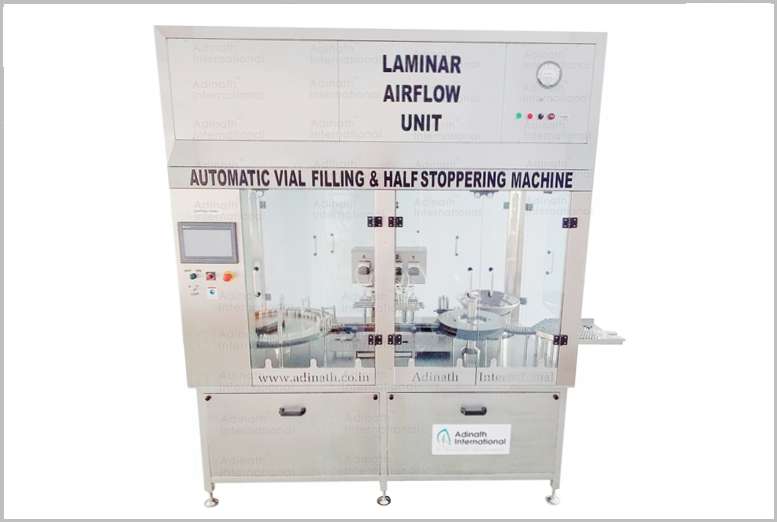
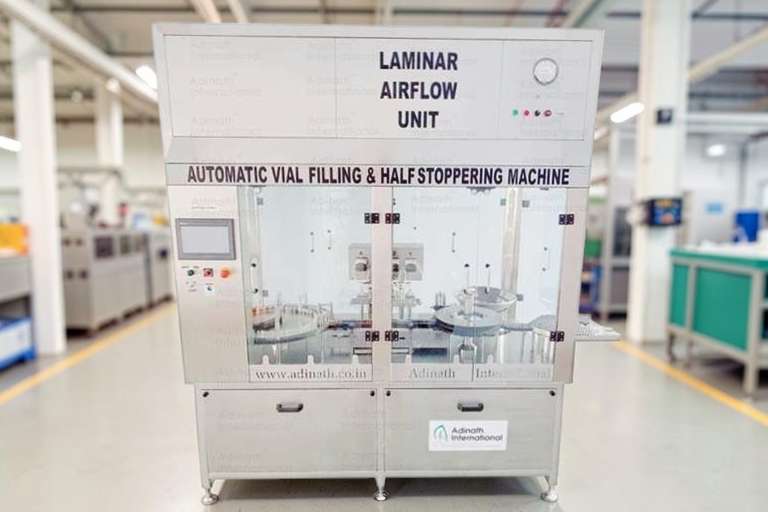
Vial Liquid Filling Machine (also known as the Injection Vial Filling Machine) is a small device that is intended to fill liquid injection vials used in pharmaceuticals. It also includes a stoppering machine. The monobloc machine known as a filler is capable of doing both filling and stoppering/bunging tasks on the same platform. For GMP compliance, all continuous parts are constructed from stainless steel or FDA-approved materials. There are several filling pump alternatives that offer ±1% filling precision. Additionally, we provide a fully automated Vial Filling Sealing Labelling Line with our Vial Cap Sealing Machine and Vial Labling Machine. The output of our filler range is between 20 and 250 VPM.
The vial filling component of the machine is responsible for dispensing precise amounts of liquid product into each vial. The rubber stoppering component inserts a rubber stopper into the vial to prevent contamination or leakage, and the cap sealing component applies a closure to the vial to complete the sealing process. This type of machine is designed to perform several functions in a single operation, making it a highly efficient and effective tool for pharmaceutical manufacturing.
These machines are typically used in high-volume production settings, where accuracy, speed, and reliability are crucial for efficient production. They are also often used in cleanroom environments to ensure that products are produced in a sterile and controlled environment. Overall, vial filling, rubber stoppering, and cap sealing machines are essential tools for pharmaceutical manufacturing, enabling manufacturers to produce high-quality products with speed, efficiency, and precision.
The incoming dry vials (sterilized and siliconized) are fed through the unscrambler and suitably guided on the moving Delrin slat conveyor belt at the required speed of the correct placement below filling unit.
The filling unit consists of Filling Head, Syringes & Nozzles; Syringes & Nozzles are made of AISI SS 316L materials. A Star Wheel is provided which holds the vial during filling operation. A sensor is provided for ”No Vial-No Filling” operation. Syringes are mounted on eccentric block and driving through bottom main gear box. Volume can be increase & decrease by increasing or decreasing stroke length of piston as per filling size. Syringes is having non return valve for sucking and delivering situation to avoid volume variation. Liquid reaches to filling nozzles through silicon transparent pipe. Nozzles having up & down movement with help of cam mechanism, and it come down when vial hold by starwheel for filling operation and starts filling when it starts to move up and after completion of filling operation, starwheel delivers two vials together on conveyor for rubber stoppering operation.
Stoppering unit consist of Star wheel, Vibrator unit and Bowl. The sterilized and siliconized rubber stoppers stored in the vibrator bowl moves vertically to the rubber stopper chute. The vial is hold firmly by starwheel, which will be in continuous rotary motion and vial which is coming from filling unit get in to starwheel and move in rotary direction along with starwheel, during movement it picks up the rubber stopper from the exit end of the chute and rubber stopper pressed by fix single pressing roller, which is spring loaded. Then vial further move on conveyor and collected on out feed starwheel for next sealing operation.
Model | ALVF-40 | ALVF-80 | ALVF-120 | ALVF – 250 |
Filling Heads | Two | Four | Eight | Twelve |
Production Rate | Up to 40 Vials/Minute | Up to 80 Vials/Minute | Up to 150 Vials/Minute | Up to 250 Vials/Minute |
Input Specification | ||||
Vial Diameter | 15mm to 70mm | 15mm to 70mm | 15mm to 70mm | 15mm to 70mm |
Vial Height | 25mm to 140mm | 25mm to 140mm | 25mm to 140mm | 25mm to 140mm |
Filling Precision | ±1% | ±1% | ±1% | ±1% |
Power Required | 1 H.P. | 1.5 H.P. | 2 H.P. | 2 H.P. |
Electrical Characteristics | 440 Volts, 3 Phase, 50 Hertz | 440 Volts, 3 Phase, 50 Hertz | 440 Volts, 3 Phase, 50 Hertz | 440 Volts, 3 Phase, 50 Hertz |
Overall Dimension | 2050mm (L) x 850mm (W) x 1700mm (H) | 2200mm (L) x 850mm (W) x 1700mm (H) | 3000mm (L) x 945mm (W) x 1700mm (H) | 3500mm (L) x 945mm (W) x 1700mm (H) |
* Power voltage can be adjusted as per customer’s domestic power voltage requirements.
* Rights of technical improvements & modification reserved.
* Illustrations & dimensions are shown for information purpose only.
Vial liquid filling machines are modular and often integrated into complete production lines. Common components include:
A Vial Liquid Filling Machine is a monoblock automatic system designed for precise filling of sterile liquids into glass vials followed by rubber stoppering. It is widely used in the pharmaceutical industry for injectable products such as vaccines, antibiotics, biotech formulations, and other parenteral liquids. The machine performs filling and stoppering on a single platform under aseptic conditions to minimize contamination.
The machine is available in different models:
Output depends on vial size, fill volume, and liquid viscosity. Speed is easily adjustable with a variable AC frequency drive.
The machine handles 2 ml to 250 ml fill volumes.
It supports quick changeover with minimal change parts for different vial formats and is compatible with various rubber stoppers (full or half stoppering).
The Vial Liquid Filling Machine offers a filling accuracy of ±1% (or better depending on liquid characteristics). It uses high-precision SS 316L syringes, piston pumps with non-return valves, and a diving nozzle system with cam-operated movement to ensure accurate, drip-free, and foam-free filling.
Key features include:
United States | Canada | Mexico | Brazil | Argentina | Chile | Colombia | Peru | Germany | United Kingdom | France | Italy | Spain | Netherlands | Belgium | Switzerland | Sweden | Austria | Denmark | Norway | Poland | Finland | Czech Republic | Hungary | Portugal | Ireland | Greece | Slovakia | Romania | Bulgaria | China | Japan | India | South Korea | Indonesia | Vietnam | Thailand | Malaysia | Philippines | Singapore | Bangladesh | Pakistan | Saudi Arabia | United Arab Emirates | Israel | Turkey | Iran | Qatar | Kuwait | South Africa | Nigeria | Egypt | Algeria | Morocco | Kenya | Ghana | Tunisia | Australia | New Zealand | Russia | Ukraine | Belarus | Kazakhstan | Taiwan | Hong Kong | South Sudan | Uzbekistan | Oman | Jordan | Bahrain | Sri Lanka | Myanmar | Lebanon | Mongolia | Ethiopia | Libya | Angola | Zambia | Zimbabwe | Mozambique | Ivory Coast | Senegal | Uganda | Tanzania | Botswana | Ecuador | Venezuela | Bolivia | Paraguay | Uruguay | Trinidad and Tobago | Panama | Guatemala | Costa Rica | Honduras | El Salvador | Nicaragua | Dominican Republic | Haiti | Cuba
Connect with our engineering team to discuss your specific production requirements. We provide customized, cGMP-compliant machinery solutions designed to optimize your manufacturing facility and maximize output.
©Adinath International | Theme Developed By Pharma Machinery Manufacturer
WhatsApp us
