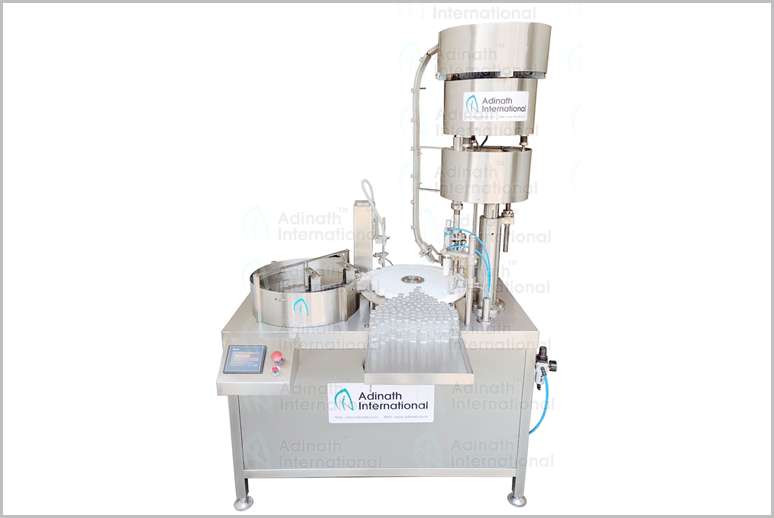
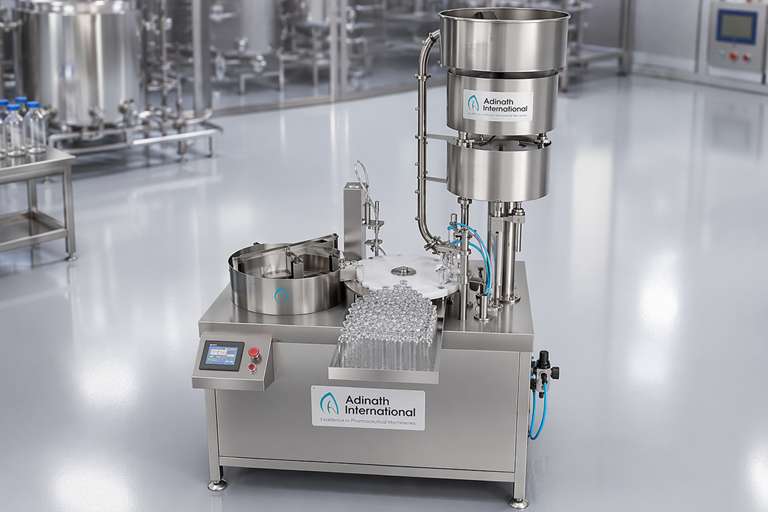
Adinath International, a trusted leader in pharmaceutical machinery manufacturing with decades of industry experience, offers high-performance Vial Filler and Capper designed for precise filling, stoppering, and cap sealing of pharmaceutical glass vials. Our automatic vial filler and capper is engineered to meet the stringent requirements of injectable liquid production, ensuring accuracy, sterility, and efficiency in every operation. The vial filler and sealer machine features a specially developed SS 316L filling pump and precision 316L stainless steel syringes that deliver exceptional filling accuracy of ±1%. The system includes a robust turntable, stainless steel slat conveyor belt, and advanced eccentric pre-gassing, filling, and post-gassing stations. Non-toxic synthetic rubber tubing and a compact, user-friendly control panel further enhance operational safety and convenience.
One of the key design advantages is the minimal distance between the filling and stoppering units, which significantly reduces the risk of contamination. The entire machine is built for use in sterile environments with laminar flow protection. The un-scrambler has been thoughtfully redesigned to eliminate dead ends and problematic areas, ensuring smooth vial movement and maintaining the highest hygiene standards. Our pharmaceutical vial filling machines support a wide filling range from 2 ml to 250 ml, making them suitable for various dosage requirements. Available in multiple configurations, these machines deliver production outputs ranging from 20 Vials Per Minute (VPM) for lab and pilot scale to 300 VPM for high-volume commercial production.
As an experienced manufacturer and exporter, Adinath International ensures every vial filler capper complies with cGMP guidelines and international quality standards. We also provide complete automatic vial filling, capping, and labeling lines by integrating our high-quality Vial Capper Machine and Vial Labeller Machine. This turnkey solution streamlines the entire packaging process while maintaining product integrity and minimizing human intervention. Backed by continuous research, rigorous testing, and real-world performance across global pharmaceutical facilities, our vial filling equipment delivers consistent results with minimal downtime and easy maintenance. Whether you operate a small-scale facility or a large sterile manufacturing plant, our machines offer the reliability and precision pharmaceutical companies demand. For manufacturers seeking a dependable partner in injectable vial packaging solutions, Adinath International combines deep technical expertise with customer-focused customization. Contact us today to explore the right automatic vial filling and capping machine for your production requirements.
The incoming dry vials (sterilized and siliconized) are fed through the unscrambler and suitably guided on the moving Delrin slat conveyor belt at the required speed of the correct placement below filling unit.
The filling unit consists of Filling Head, Syringes & Nozzles; Syringes & Nozzles are made of AISI SS 316L materials. A Star Wheel is provided which holds the vial during filling operation. A sensor is provided for ”No Vial-No Filling” operation. Syringes are mounted on eccentric block and driving through bottom main gear box. Volume can be increase & decrease by increasing or decreasing stroke length of piston as per filling size. Syringes is having non return valve for sucking and delivering situation to avoid volume variation. Liquid reaches to filling nozzles through silicon transparent pipe. Nozzles having up & down movement with help of cam mechanism, and it come down when vial hold by starwheel for filling operation and starts filling when it starts to move up and after completion of filling operation, starwheel delivers two vials together on conveyor for rubber stoppering operation.
Stoppering unit consist of Star wheel, Vibrator unit and Bowl. The sterilized and siliconized rubber stoppers stored in the vibrator bowl moves vertically to the rubber stopper chute. The vial is hold firmly by starwheel, which will be in continuous rotary motion and vial which is coming from filling unit get in to starwheel and move in rotary direction along with starwheel, during movement it picks up the rubber stopper from the exit end of the chute and rubber stopper pressed by fix single pressing roller, which is spring loaded. Then vial further move on conveyor and collected on out feed starwheel for next sealing operation.
Model | ALVF-40 | ALVF-80 | ALVF-120 | ALVF – 250 |
Filling Heads | Two | Four | Eight | Twelve |
Production Rate | Up to 40 Vials/Minute | Up to 80 Vials/Minute | Up to 150 Vials/Minute | Up to 250 Vials/Minute |
Vial Diameter | 15mm to 70mm | 15mm to 70mm | 15mm to 70mm | 15mm to 70mm |
Vial Height | 25mm to 140mm | 25mm to 140mm | 25mm to 140mm | 25mm to 140mm |
Filling Precision | ±1% | ±1% | ±1% | ±1% |
Power Required | 1 H.P. | 1.5 H.P. | 2 H.P. | 2 H.P. |
Electrical Characteristics | 440 Volts, 3 Phase, 50 Hertz | 440 Volts, 3 Phase, 50 Hertz | 440 Volts, 3 Phase, 50 Hertz | 440 Volts, 3 Phase, 50 Hertz |
Overall Dimension | 2050mm (L) x 850mm (W) x 1700mm (H) | 2200mm (L) x 850mm (W) x 1700mm (H) | 3000mm (L) x 945mm (W) x 1700mm (H) | 3500mm (L) x 945mm (W) x 1700mm (H) |
* Power voltage can be adjusted as per customer’s domestic power voltage requirements.
* Rights of technical improvements & modification reserved.
* Illustrations & dimensions are shown for information purpose only.
A Vial Filler and Capper (also known as Monoblock Vial Filling, Stoppering & Capping Machine) is an automatic system that performs filling, rubber stoppering, and capping/sealing of glass vials in one continuous operation. It is designed for sterile injectable production (liquids or powders) in the pharmaceutical and biotech industries, minimizing contamination risk and human intervention.
The machine typically delivers 30 to 250 vials per minute, depending on the model (e.g., two-head or multi-head configurations), vial size, and product type. For example, two-head models handle medium-scale production efficiently, while higher-head variants support high-volume commercial batches. Speed is adjustable via variable frequency drive.
It accommodates round glass vials from 5 ml to 250 ml (diameter 15–70 mm, height 25–140 mm). Fill volumes range from 50 mg to 10 grams for powders and 2 ml to 250 ml for liquids. The machine supports various rubber stopper (13–32 mm) and cap types with quick-change parts for fast format changeovers.
Filling accuracy is ±0.5% to ±1% for liquids (piston or peristaltic pumps) and ±1% to ±2% for powders (vacuum wheel system), depending on product density and consistency. Precision dosing systems, combined with “No Vial – No Filling,” ensure uniform results and minimal wastage.
The monoblock design integrates filling, stoppering, and capping with minimal distance between stations, significantly reducing open-vial exposure time and contamination risk. It operates effectively under laminar airflow, uses SS316L contact parts (autoclavable), and supports nitrogen flushing — making it ideal for aseptic processing of antibiotics, vaccines, and biologics.
Important features include the “No Vial – No Filling” and “No Vial – Machine Stop” systems, safety clutch to prevent vial breakage, individual drives for synchronized operation, digital production counter, and overload protection. Agitators (for powder) and precise cam mechanisms maintain consistent flow and accuracy throughout the process.
Yes. It is cGMP and CE compliant and meets FDA, EU-GMP, and WHO standards. Customizations include PLC with HMI, inbuilt laminar airflow, servo motors, in-process weight checking, CIP/SIP capability, and different filling systems (piston/peristaltic for liquids or vacuum wheel for powders). IQ/OQ documentation is provided for easy validation.
United States | Canada | Mexico | Brazil | Argentina | Chile | Colombia | Peru | Germany | United Kingdom | France | Italy | Spain | Netherlands | Belgium | Switzerland | Sweden | Austria | Denmark | Norway | Poland | Finland | Czech Republic | Hungary | Portugal | Ireland | Greece | Slovakia | Romania | Bulgaria | China | Japan | India | South Korea | Indonesia | Vietnam | Thailand | Malaysia | Philippines | Singapore | Bangladesh | Pakistan | Saudi Arabia | United Arab Emirates | Israel | Turkey | Iran | Qatar | Kuwait | South Africa | Nigeria | Egypt | Algeria | Morocco | Kenya | Ghana | Tunisia | Australia | New Zealand | Russia | Ukraine | Belarus | Kazakhstan | Taiwan | Hong Kong | South Sudan | Uzbekistan | Oman | Jordan | Bahrain | Sri Lanka | Myanmar | Lebanon | Mongolia | Ethiopia | Libya | Angola | Zambia | Zimbabwe | Mozambique | Ivory Coast | Senegal | Uganda | Tanzania | Botswana | Ecuador | Venezuela | Bolivia | Paraguay | Uruguay | Trinidad and Tobago | Panama | Guatemala | Costa Rica | Honduras | El Salvador | Nicaragua | Dominican Republic | Haiti | Cuba
Connect with our engineering team to discuss your specific production requirements. We provide customized, cGMP-compliant machinery solutions designed to optimize your manufacturing facility and maximize output.
Algeria | Angola | Argentina | Australia | Austria | Bahrain | Bangladesh | Belarus | Belgium | Bolivia | Botswana | Brazil | Bulgaria | Canada | Chile | China | Colombia | Costa Rica | Cuba | Czech Republic | Denmark | Dominican Republic | Ecuador | Egypt | El Salvador | Ethiopia | Finland | France | Germany | Ghana | Greece | Guatemala | Haiti | Honduras | Hong Kong | Hungary | India | Indonesia | Iran | Ireland | Israel | Italy | Ivory Coast | Japan | Jordan | Kazakhstan | Kenya | Kuwait | Lebanon | Libya | Malaysia | Mexico | Mongolia | Morocco | Mozambique | Myanmar | Netherlands | New Zealand | Nicaragua | Nigeria | Norway | Oman | Pakistan | Panama | Paraguay | Peru | Philippines | Poland | Portugal | Qatar | Romania | Russia | Saudi Arabia | Senegal | Slovakia | Singapore | South Africa | South Korea | South Sudan | Spain | Sri Lanka | Sweden | Switzerland | Taiwan | Tanzania | Thailand | Trinidad and Tobago | Tunisia | Turkey | Uganda | Ukraine | United Arab Emirates | United Kingdom | United States | Uruguay | Uzbekistan | Venezuela | Vietnam | Zambia | Zimbabwe
Connect with our engineering team to discuss your specific production requirements. We provide customized, cGMP-compliant machinery solutions designed to optimize your manufacturing facility and maximize output.
©Adinath International | Theme Developed By Pharma Machinery Manufacturer I Website updated on: 02 October 2026
WhatsApp us
