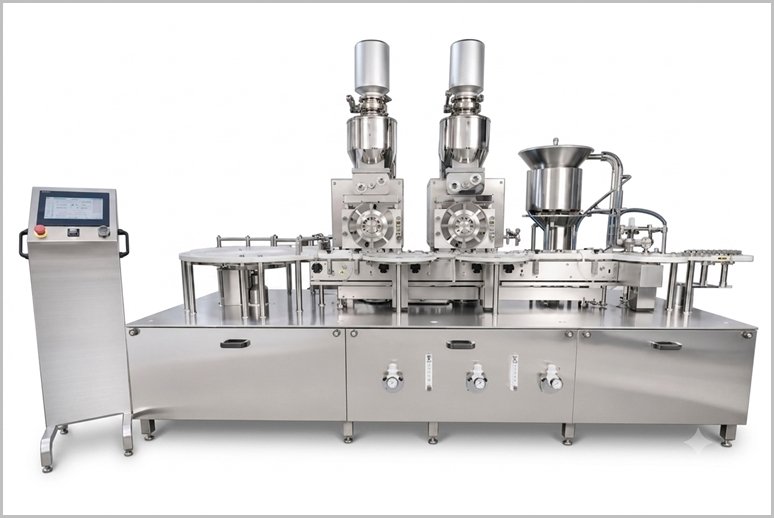
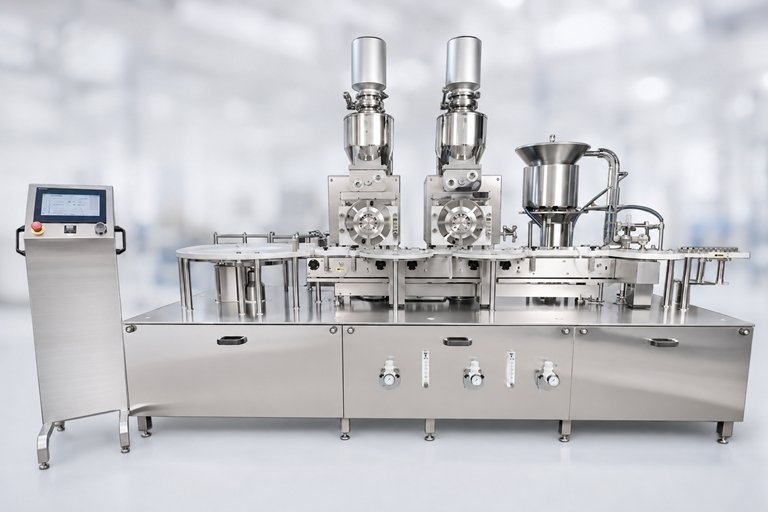
Dry Powder Injection Filler is specialized aseptic pharmaceutical equipment designed to precisely dose sterile dry powders into glass or plastic vials. These powders are later reconstituted with a diluent for injectable administration. It is essential for drugs that are unstable in liquid form, such as certain antibiotics, antimicrobials, and other sensitive formulations, because the dry state extends shelf life and maintains potency. The machine typically operates as a monoblock system that combines powder filling and rubber stoppering (bunging) in one compact unit. Vials are fed via turntables or conveyors. A vacuum-pressure dosing system uses a rotating powder wheel with ports and pistons. Sterile powder from a hopper is drawn into the ports by vacuum; excess is removed by a doctor blade for volumetric accuracy. The metered dose is then gently flushed into the vial with sterilized compressed air or nitrogen gas. Immediately afterward, a rubber stopper is placed to seal the vial and protect sterility.
Key performance characteristics include filling accuracy of approximately ±1% to ±3% (depending on powder bulk density, consistency, and controlled humidity, typically below 25–28% RH), fill ranges from about 50 mg to 1.5–10 g (single or multi-dose with change parts), vial sizes commonly 5 ml to 100 ml or larger, and outputs from 60–100 vials per minute (single-head) up to 200–240 vials per minute (double-head models). Contact parts are usually SS 316L for easy autoclaving and sterilization, with frames often in SS 304. Designs follow cGMP, and many models support servo-driven controls, “no vial–no fill” interlocks, tool-less adjustments, and optional features such as pre/post gassing, online checkweighing, or SCADA/21 CFR Part 11 compliance.
Experience and practical advantages come from real-world production environments. Manufacturers and operators report reduced powder wastage, consistent dosing even with challenging free-flowing or cohesive powders, quick changeovers for different vial or fill sizes, and reliable performance under laminar airflow or isolator conditions. Compared with liquid filling or full lyophilization lines, dry powder filling often lowers energy use and supports longer product stability without refrigeration in many cases.
Expertise is embedded in the engineering: vacuum-pressure dosing avoids the shear and heat of auger systems that can degrade sensitive APIs; positive vial transport keeps containers upright; and hygienic construction with removable, sterilizable parts supports aseptic processing. These features reflect deep knowledge of pharmaceutical powder handling, bulk density variation, and cleanroom requirements.
Authoritativeness is demonstrated by widespread adoption across sterile injectable facilities worldwide. Machines are routinely specified to meet international regulatory expectations (cGMP, FDA, WHO-GMP principles) and are produced by established equipment suppliers who provide validated performance data, technical specifications, and support for qualification (IQ/OQ/PQ).
Trustworthiness rests on transparent design choices that prioritize patient safety and product quality: sterile material contact surfaces, interlocks that prevent under- or over-filling, controlled environments that limit contamination risk, and accurate, repeatable dosing that reduces batch variability. When operated under proper humidity control and validated procedures, the equipment helps ensure that every vial meets label claim and remains free from microbial or particulate contamination until reconstitution and use.
In summary, a Dry Powder Injection Filler delivers precise, sterile, high-throughput filling of sensitive injectable powders while supporting regulatory compliance, operational efficiency, and long-term product integrity. It remains a cornerstone technology for modern parenteral manufacturing.
The sterilized powder is stored in the powder hopper, where a pair of mechanical agitators continuously blend it to ensure consistent flow characteristics and uniform bulk density. Directly beneath the hopper, a powder wheel with twelve ports rotates at a precisely controlled, pre-set speed with virtually zero clearance. Each port contains a piston, and a vacuum plate sits immediately behind the wheel. Spring pressure maintains firm contact between the vacuum plate and the powder wheel, eliminating any gap. As the wheel turns, vacuum draws an exact volume of powder into each port. The fill volume is governed by the piston length, enabling different dose sizes to be achieved. Excess powder is removed by a doctor blade, which can be adjusted externally without removing the powder hopper.
Vacuum continues to hold the powder in the port as the wheel indexes forward. When a filled port aligns directly above the container, a timed pulse of sterilized low-pressure compressed air (or nitrogen) is released. This pulse sequentially ejects the powder from the port into the container, one precise dose at a time. Immediately after filling, a vial separator spaces the containers on the conveyor and moves them forward for stoppering. Sterilized, siliconized rubber stoppers are held in a vibratory bowl, from which they are oriented and fed into a vertical chute where they stack neatly. Each container is firmly gripped between a pair of timing belts so it can pick up a stopper from the chute exit. The container then passes between two pressing rollers that firmly seat the stopper, ensuring a tight and secure seal.
Models | APF 12S | APF 12D |
Production Output | Up to 100 vials/minute | Up to 200 vials/minute |
Fill Volume | 50 mg. to 10grams | 50 mg. to 10 grams |
Vial Size | 5ml to 250ml | 5ml to 250ml |
Filling Accuracy | ± 2 – 3% in single dosing depending upon consistency and uniformity of bulk density of Injectable Powder | ± 2 – 3% in single dosing depending upon consistency and uniformity of bulk density of Injectable Powder |
Power Load | 3.5 H. P. | 4.5 H. P. |
Overall Dimension | 2600mm (L) X 1100mm (W) X 1800mm (H) approx. | 3000mm (L) X 1100mm (W) X 1800mm (H) approx. |
Net Weight | 500 kgs. approx. | 700 kgs. approx. |
Gross Weight | 750 kgs. approx. | 950 kgs. approx. |
* Power voltage can be adjusted as per customer’s domestic power voltage requirements.
* Rights of technical improvements & modification reserved.
* Illustrations & dimensions are shown for information purpose only.
A Dry Powder Injection Filler is specialized aseptic pharmaceutical equipment that accurately dispenses precise doses of sterile dry powder into glass vials under controlled sterile conditions, followed by rubber stoppering or sealing to ensure an airtight closure.
The machine uses a vacuum-pressure dosing system with a rotating powder wheel. Sterile powder is drawn into metered ports by vacuum, excess is removed by a doctor blade, and the exact dose is gently flushed into the vial using sterilized air or nitrogen. Rubber stoppers are then applied immediately for sealing.
It is ideal for beta-lactam antibiotics, acyclovir, spray-freeze-dried pellets, biologics, and other pharmaceuticals or multi-dose formulations that are unstable as ready-to-use liquids. It also handles crystalline powders and excipient-blended formulations used in pharmaceuticals, cosmetics, and related industries.
Filling accuracy is generally ±1% to ±3%, depending on the powder’s bulk density, consistency, and environmental conditions such as controlled humidity (usually below 25–28% RH).
Most models accommodate glass vials from 5 ml to 100 ml (some up to 250 ml) and fill volumes ranging from 50 mg to 1.5–10 grams per dose. Multi-dosing is possible with change parts for higher fill weights.
Output typically ranges from 60–100 vials per minute for single-head models and up to 200–240 vials per minute for double-head high-speed versions, depending on fill volume, powder characteristics, and vial size.
Dry powder filling is more cost-effective than full lyophilization. It requires less energy and infrastructure while still preserving drug efficacy and providing excellent long-term stability for moisture-sensitive formulations.
Yes. All product-contact parts are manufactured from SS 316L stainless steel and are designed for easy removal and autoclaving/sterilization to maintain full aseptic compliance.
Yes. Dry Powder Injection Fillers are built to cGMP standards and support compliance with FDA, WHO-GMP, and other international regulatory requirements for sterile injectable manufacturing.
Absolutely. These machines are commonly supplied as monoblock units (filling + stoppering) and can be seamlessly integrated with vial washing, sterilization tunnels, capping, labeling, and inspection systems for a complete sterile powder filling line.
Algeria | Angola | Argentina | Australia | Austria | Bahrain | Bangladesh | Belarus | Belgium | Bolivia | Botswana | Brazil | Bulgaria | Canada | Chile | China | Colombia | Costa Rica | Cuba | Czech Republic | Denmark | Dominican Republic | Ecuador | Egypt | El Salvador | Ethiopia | Finland | France | Germany | Ghana | Greece | Guatemala | Haiti | Honduras | Hong Kong | Hungary | India | Indonesia | Iran | Ireland | Israel | Italy | Ivory Coast | Japan | Jordan | Kazakhstan | Kenya | Kuwait | Lebanon | Libya | Malaysia | Mexico | Mongolia | Morocco | Mozambique | Myanmar | Netherlands | New Zealand | Nicaragua | Nigeria | Norway | Oman | Pakistan | Panama | Paraguay | Peru | Philippines | Poland | Portugal | Qatar | Romania | Russia | Saudi Arabia | Senegal | Slovakia | Singapore | South Africa | South Korea | South Sudan | Spain | Sri Lanka | Sweden | Switzerland | Taiwan | Tanzania | Thailand | Trinidad and Tobago | Tunisia | Turkey | Uganda | Ukraine | United Arab Emirates | United Kingdom | United States | Uruguay | Uzbekistan | Venezuela | Vietnam | Zambia | Zimbabwe
Connect with our engineering team to discuss your specific production requirements. We provide customized, cGMP-compliant machinery solutions designed to optimize your manufacturing facility and maximize output.
©Adinath International | Theme Developed By Pharma Machinery Manufacturer I Website updated on: 09 October 2026
WhatsApp us
