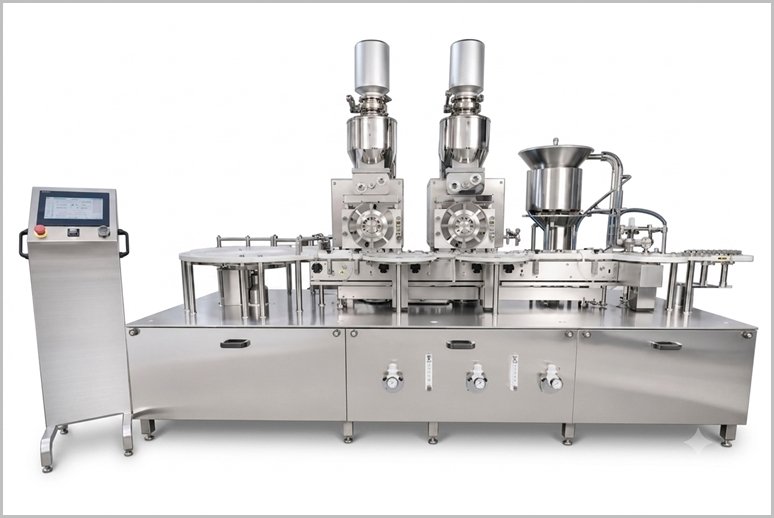
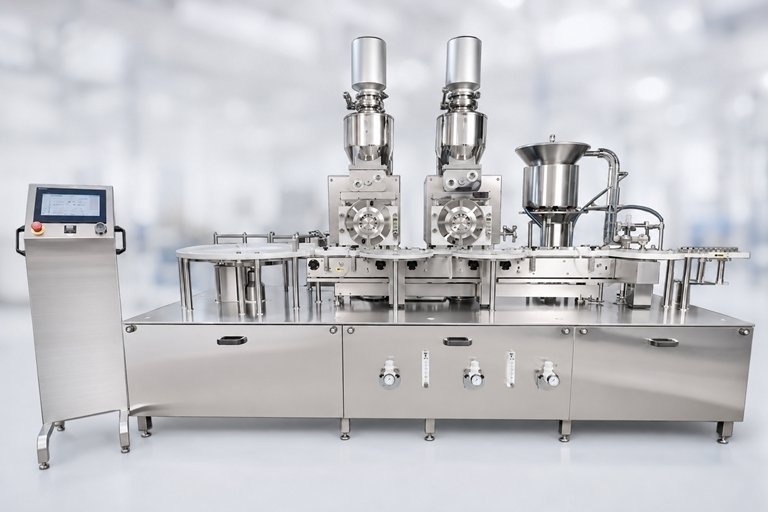
Sterile Powder Filling Machine is specialized pharmaceutical equipment designed for the accurate, contamination-free filling of sterile dry powders into glass vials under strict aseptic conditions. Also known as an injectable powder filling machine, vial dry powder filler, or aseptic powder filler, this machine plays a critical role in producing antibiotics, vaccines, cephalosporins, penicillin formulations, lyophilized products, and other moisture-sensitive parenteral drugs that cannot remain stable in liquid form.
Modern sterile powder filling machines operate as compact, monobloc systems that combine precise powder dosing with rubber stoppering on a single platform. This integrated design minimizes handling, reduces contamination risk, and optimizes cleanroom space. Contact parts are typically constructed from stainless steel 316L or FDA-approved materials, ensuring full compliance with cGMP, WHO-GMP, and other global regulatory standards. Easy-removal designs allow thorough autoclaving and sterilization between batches, supporting rigorous hygiene protocols essential for sterile injectable production.
These machines commonly use vacuum-driven powder wheels or servo-controlled dosing systems for high accuracy, typically achieving ±1% to ±3% fill precision depending on powder characteristics and controlled humidity (often maintained below 28–30% RH). Fill ranges generally span 50 mg to 1.5 g per single dose, with multi-dose capabilities extending to higher weights. Production speeds vary by model—from 60 to over 200 vials per minute—making them suitable for both mid-scale and high-volume manufacturing. Essential safety and efficiency features include “no vial – no fill” systems to eliminate costly powder waste, tool-less adjustments for quick changeovers, built-in rubber stoppering units, variable frequency drives, and digital counters. Advanced models support isolator or RABS integration, real-time monitoring, and optional 21 CFR Part 11-compliant software for data integrity. Servo motors control powder wheel rotation and vial transport, delivering consistent performance while reducing operator intervention.
Investing in a high-quality sterile powder filling machine delivers measurable advantages in sterility assurance, dosage uniformity, and operational efficiency. By maintaining aseptic conditions throughout filling and stoppering, these systems help manufacturers meet stringent requirements under EU GMP Annex 1, FDA guidelines, and ISO cleanroom standards. Minimal powder wastage, high throughput, and reduced human contact lower contamination risks and improve yield. The hygienic SS 316L construction and CIP/SIP-compatible designs simplify validation, cleaning, and changeovers, supporting both clinical-scale and commercial production. Applications extend across pharmaceutical, biotechnology, and contract manufacturing organizations producing sterile dry powder injectables. Whether handling free-flowing antibiotics or more challenging powders, the machine’s adaptability with change parts for different vial sizes (typically 5 ml to 100 ml) and stopper diameters ensures flexibility across product portfolios.
Manufacturers with decades of experience in pharmaceutical machinery design these systems based on deep process knowledge of powder flow dynamics, bulk density variations, and aseptic processing challenges. Authoritative engineering focuses on contamination control, precise gravimetric or volumetric dosing, and full documentation support (IQ/OQ) to facilitate regulatory audits. Trust is reinforced through proven performance in global installations, adherence to international quality standards, and continuous innovation in automation and containment technologies.
Choosing a reliable sterile powder filling machine means partnering with equipment that prioritizes product integrity, patient safety, and manufacturing excellence. For pharmaceutical companies seeking scalable, compliant, and efficient aseptic powder filling solutions, this technology remains indispensable in modern sterile injectable production lines. Target Keywords integrated naturally: sterile powder filling machine, injectable powder filling machine, vial dry powder filling machine, aseptic powder filler, sterile vial powder filler, cGMP powder filling equipment, pharmaceutical sterile powder filler.
The sterilized powder is held in the powder hopper and continuously agitated by a pair of mechanical agitators. This maintains consistent flow and uniform bulk density throughout the filling process. Below the hopper, an eight-port powder wheel rotates at a preset speed with virtually no clearance. Each port contains a piston, and a vacuum plate is positioned tightly against the rear of the powder wheel. Constant back-spring pressure ensures zero clearance between the powder wheel and the vacuum plate. As the wheel turns, a precise volume of powder is drawn into each port by vacuum. Different fill volumes are achieved simply by adjusting the piston length. Excess powder is cleanly removed by a doctor blade. The doctor blades can be adjusted from outside the machine without the need to remove the powder hopper.
The powder remains held in the port by vacuum until the port reaches the position directly above the waiting container. At that point, a timed dose of sterilized low-pressure compressed air (or nitrogen gas) sequentially ejects the powder from the port into the container. Immediately after filling, the containers are separated on the conveyor by a vial separator and advanced to the stoppering station. Different groove separators can be fitted according to container diameter or multiple-dosing requirements. Sterilized, siliconized rubber stoppers are stored in a vibratory bowl feeder. They are oriented and fed into a vertical chute where they stack ready for use. Each filled container is firmly gripped between a pair of timing belts, which pick up a rubber stopper from the exit end of the chute. The container then passes between two pressing rollers that press the stopper firmly into place for a tight, secure seal.
Models | APF 12S | APF 12D |
Production Output | Up to 100 vials/minute | Up to 200 vials/minute |
Fill Volume | 50 mg. to 10grams | 50 mg. to 10 grams |
Vial Size | 5ml to 250ml | 5ml to 250ml |
Filling Accuracy | ± 2 – 3% in single dosing depending upon consistency and uniformity of bulk density of Injectable Powder | ± 2 – 3% in single dosing depending upon consistency and uniformity of bulk density of Injectable Powder |
Power Load | 3.5 H. P. | 4.5 H. P. |
Overall Dimension | 2600mm (L) X 1100mm (W) X 1800mm (H) approx. | 3000mm (L) X 1100mm (W) X 1800mm (H) approx. |
Net Weight | 500 kgs. approx. | 700 kgs. approx. |
Gross Weight | 750 kgs. approx. | 950 kgs. approx. |
|
|
|
* Power voltage can be adjusted as per customer’s domestic power voltage requirements.
* Rights of technical improvements & modification reserved.
* Illustrations & dimensions are shown for information purpose only.
When selecting a sterile powder filling machine, consider the following key factors:
A Sterile Powder Filling Machine is specialized pharmaceutical equipment designed to accurately fill sterile dry powders into glass vials under aseptic conditions. It is widely used for injectable products such as antibiotics, vaccines, and other moisture-sensitive formulations.
The machine offers high volumetric filling accuracy of ±2% (depending on powder characteristics and controlled humidity levels). Precision is achieved by adjusting the piston depth in the powder wheel ports.
Production output typically ranges from 60 to 200 vials per minute, depending on the model (single or double powder wheel), fill volume, powder properties, and vial size.
All product contact parts are made of Stainless Steel 316L or FDA-approved materials. The machine frame is built to cGMP standards, ensuring durability, corrosion resistance, and easy sterilization.
Yes. The “No Vial – No Filling” system automatically stops powder dosing when no vial is present under the filling station, preventing wastage of costly sterile powder.
Yes. The machine supports multiple dosing (single, double, triple, or quadruple) with the help of change parts, allowing fill ranges typically from 50 mg up to several grams.
Yes. The built-in rubber stoppering unit performs filling and stoppering on the same platform. This saves valuable space in the sterile area and reduces the length of the required laminar airflow zone.
Yes. All contact parts are designed for easy removal, making autoclaving and sterilization simple and efficient between batches, in full compliance with aseptic manufacturing requirements.
Key safety features include a safety clutch system to prevent vial breakage, motors protected by contactors and relays against overload or jamming, and variable AC frequency drive for controlled speed adjustment.
Yes. The machine is fully designed as a compact cGMP model and meets current Good Manufacturing Practice standards, making it suitable for regulated pharmaceutical production environments.
Algeria | Angola | Argentina | Australia | Austria | Bahrain | Bangladesh | Belarus | Belgium | Bolivia | Botswana | Brazil | Bulgaria | Canada | Chile | China | Colombia | Costa Rica | Cuba | Czech Republic | Denmark | Dominican Republic | Ecuador | Egypt | El Salvador | Ethiopia | Finland | France | Germany | Ghana | Greece | Guatemala | Haiti | Honduras | Hong Kong | Hungary | India | Indonesia | Iran | Ireland | Israel | Italy | Ivory Coast | Japan | Jordan | Kazakhstan | Kenya | Kuwait | Lebanon | Libya | Malaysia | Mexico | Mongolia | Morocco | Mozambique | Myanmar | Netherlands | New Zealand | Nicaragua | Nigeria | Norway | Oman | Pakistan | Panama | Paraguay | Peru | Philippines | Poland | Portugal | Qatar | Romania | Russia | Saudi Arabia | Senegal | Slovakia | Singapore | South Africa | South Korea | South Sudan | Spain | Sri Lanka | Sweden | Switzerland | Taiwan | Tanzania | Thailand | Trinidad and Tobago | Tunisia | Turkey | Uganda | Ukraine | United Arab Emirates | United Kingdom | United States | Uruguay | Uzbekistan | Venezuela | Vietnam | Zambia | Zimbabwe
Connect with our engineering team to discuss your specific production requirements. We provide customized, cGMP-compliant machinery solutions designed to optimize your manufacturing facility and maximize output.
©Adinath International | Theme Developed By Pharma Machinery Manufacturer I Website updated on: 08 October 2026
WhatsApp us
